On CNN Money, urban chickens in NYC!
Showing posts with label sustainability. Show all posts
Showing posts with label sustainability. Show all posts
Saturday, July 31, 2010


Wednesday, April 28, 2010
Using Available Home Space
Back when I was still working at Microsoft, I got an opportunity to work on a CD-ROM project (Remember, children, back before the web could do things like stream multimedia content, there was this brief period in history where people got their content on CD-ROMS! thus ends your history lesson for the day).
This project happened to be on Frank Lloyd Wright (I can't believe it, but I actually found the link to several used copies on Amazon.com!), and included a biography and photos and text on most of his structures, as well as cutting-edge (for the day) three-dimensional walkthroughs of some of his most famous houses, like the Ennis House , which by the way has appeared in the culturally iconic Karate Kid movies (number III, I believe) as well as in Buffy the Vampire Slayer.
While Frank Lloyd Wright didn't design homes in the time of "Green Building" and "Sustainable Development", which are hot topics now in the architectural world, he did often make very good use of small spaces and natural heating and cooling, especially in his series of Usonian Houses , which were made to be modular, partially constructed by the owner themselves, and employed natural cooling (no air conditioning) and radiant floor heating under a tinted-concrete slab (something newer green homes are emulating). If you want to take a look at the way he used very small spaces with efficient built-in furniture and unique features like pull-out kitchen countertops (much like the roll-out breadboards), the book Wright-Sized Houses
 has some beautiful photos and inspirational ideas to incorporate.
During the time that I worked on this project, we got the opportunity to take a tour of the Brandes house in Sammamish, Washington. and were able to see first-hand some of the innovative ways that Wright used small spaces and inexpensive construction as well as his signature connection to the environment in which the house was situated. That style of home was brought to mind when I saw the following video. This young architect has taken the notion of using small spaces and built-in functionality to an incredible extreme, and we could all learn something from his ability to think outside the box when it comes to space and design!
Okay, and since I'm a Lego Geek, I can't pass up on the opportunity to drool over these sets. Who can resist the Guggenheim and Falling Water in LEGO!!!

This project happened to be on Frank Lloyd Wright (I can't believe it, but I actually found the link to several used copies on Amazon.com!), and included a biography and photos and text on most of his structures, as well as cutting-edge (for the day) three-dimensional walkthroughs of some of his most famous houses, like the Ennis House , which by the way has appeared in the culturally iconic Karate Kid movies (number III, I believe) as well as in Buffy the Vampire Slayer.
While Frank Lloyd Wright didn't design homes in the time of "Green Building" and "Sustainable Development", which are hot topics now in the architectural world, he did often make very good use of small spaces and natural heating and cooling, especially in his series of Usonian Houses
, which were made to be modular, partially constructed by the owner themselves, and employed natural cooling (no air conditioning) and radiant floor heating under a tinted-concrete slab (something newer green homes are emulating). If you want to take a look at the way he used very small spaces with efficient built-in furniture and unique features like pull-out kitchen countertops (much like the roll-out breadboards), the book Wright-Sized Houses has some beautiful photos and inspirational ideas to incorporate.During the time that I worked on this project, we got the opportunity to take a tour of the Brandes house in Sammamish, Washington. and were able to see first-hand some of the innovative ways that Wright used small spaces and inexpensive construction as well as his signature connection to the environment in which the house was situated. That style of home was brought to mind when I saw the following video. This young architect has taken the notion of using small spaces and built-in functionality to an incredible extreme, and we could all learn something from his ability to think outside the box when it comes to space and design!
Okay, and since I'm a Lego Geek, I can't pass up on the opportunity to drool over these sets. Who can resist the Guggenheim and Falling Water in LEGO!!!

Wednesday, March 03, 2010
Who Wins the Stupid Award??
Does it go to the guy out there in the pouring-down pissing-down rain today going at the sodden sidewalk with a leaf blower??
Or does it go to the city officials in Orange, California who are suing a couple for removing their lawn and replacing it with landscape bark and drought-tolerant plants, even though they have reduced their water usage from 299,221 gallons in 2007 to 58,348 gallons in 2009.
You be the judge.
Or does it go to the city officials in Orange, California who are suing a couple for removing their lawn and replacing it with landscape bark and drought-tolerant plants, even though they have reduced their water usage from 299,221 gallons in 2007 to 58,348 gallons in 2009.
You be the judge.
Saturday, February 13, 2010
Mad Love for Re-usable Bags
 My favorite re-usable bags are Chico Bags, I've probably raved about them here before because they're so lightweight and fold up into teeny-tiny stuff sacks just like little sleeping bags that dolls might use. They hold even heavy stuff and unlike canvas bags I don't forget them because of the nifty carabiner clips they come with that let me clip them onto everything in sight. I wish I'd seen their new Valentine's bags before today, aren't they cute??
So today I'm at a store across town and I tell the checker I don't need a bag because I brought my own, but she had already started putting things in a bag, so she takes the two items out and then throws that bag in the garbage. Like two self-contained rolls of masking tape are going to contaminate the bag. Sometimes I wonder if there's a little "Piss off the environmentalist" board game that they secretly play where you get points for something like that. Maybe the lady who almost ran me over in the crosswalk today with her 80-ton SUV talking (now illegally) on her phone was playing too. Or maybe it's just that they don't really think anything of just taking a perfectly good plastic bag and throwing it away for no reason whatsoever.
But while the checker was wasting the bag, it occurred to me how much the culture of where we live plays into our actions. Strangely, although I was just across town from where I live, the culture of this side of town is very different from the culture on that side of town. They could really be two separate cities (which is evident every time we have elections here and the votes are split 50/50 conservative/progressive.) In my side of town, where I shop for groceries the checker just sits there expecting you to pull out your cloth bags and start putting the food in them. If you don't do that in a reasonable amount of time, they say "Oh, do you need a bag?" and pull one out for you. On the other side of town, the goods are whipped into a plastic bag so fast you can't even get the words out to tell them you don't need it before they're ripping it off of the little rack and handing it to you. Sometimes if you're really lucky, they'll put one item per bag and even double-bag the heavy things so that by the time you get home you realize you've consumed not one or two but seven or eight bags. I guess no one blinks an eye at this over there.
Where the culture expects you to bring your own bags, you actually feel kind of bad when you don't have one. No one actually makes you feel bad, but it's clear that you're not following expectations when you don't have them. You feel keenly that you're out of the ordinary if they have to pull a bag from the small stack under the counter. Where the culture expects that you'll just consume endless bags, you might not think twice about what that really means to the world.
 I know bags are a relatively small issue in the grand scheme of things (compared to say global climate change or peak oil) but they're just one indicator of how the culture around you can influence everyone's actions. If locker rooms or showers are provided at work, the message is clear that arriving by bicycle or on foot is not only acceptable but encouraged. If people scowl at you when you carry your helmet into the building or poke fun at your two-wheeled transport, it can change the way you feel about it. The only way a culture changes is by individual action, so while our actions might feel like drops in a bucket, eventually that bucket fills up and tips things in another direction entirely. Our actions are more than the sum of their individual parts, they're creating a culture in which everyone feels more comfortable acting that way as well.
By the way, if you love frogs, you can get this cool custom Chico bag by becoming a member of Save the Frogs.
Tuesday, January 12, 2010
Probably the Coolest Article About Energy Usage Ever
Okay, you've just got to read this article:
How many cyclists does it take to power a hairdryer? The answer's 18, as one family discovered in a unique TV experiment
If everyone could see the impact of their energy usage so clearly, I think peoples' behavior would change so much more easily! Very Very Cool!
How many cyclists does it take to power a hairdryer? The answer's 18, as one family discovered in a unique TV experiment
If everyone could see the impact of their energy usage so clearly, I think peoples' behavior would change so much more easily! Very Very Cool!
Tuesday, June 02, 2009
Words of Wisdom
We are continually faced with a series of great opportunities brilliantly disguised as insoluble problems.
- John W. Gardner
I thought of this quote as I biked to work last night. My bike count reached a new all-time high of 64. Basically, in any direction that I looked, I saw cyclists. Some of them parents toting kids on tag-a-longs or trailers, some of them workers returning home with messenger bags and ties, some college students, some kids on BMX bikes, but everywhere bicycles going this way and that.
To my left and right, new front and side-lawn gardens were popping up right and left. I'll try and add some photos soon of all the new creative food-growing landscaping I'm seeing. Clotheslines (or "solar clothes dryers" as right-to-dry activists are now creatively calling them) are flapping in the breeze, and neighbors sit on newly constructed front porches or stand by their garden fence talking. All of these people in ways small and large are taking the insoluble problems we now face and turning them into challenges to be met. Sure, it's a challenge to hang out your clothes when you could just throw them into the dryer in 1/8 of the time (though I would argue that the smell of line-dried laundry more than makes up for that one!) or to get out your helmet and rain jacket and bike off to work. The great thing is that almost everything that benefits the planet really benefits us even more. We get more exercise, more fresh air, we eat better, we know more of our neighbors when we engage in sustainable living. We're not saving the earth, we're saving ourselves.
- John W. Gardner
I thought of this quote as I biked to work last night. My bike count reached a new all-time high of 64. Basically, in any direction that I looked, I saw cyclists. Some of them parents toting kids on tag-a-longs or trailers, some of them workers returning home with messenger bags and ties, some college students, some kids on BMX bikes, but everywhere bicycles going this way and that.
To my left and right, new front and side-lawn gardens were popping up right and left. I'll try and add some photos soon of all the new creative food-growing landscaping I'm seeing. Clotheslines (or "solar clothes dryers" as right-to-dry activists are now creatively calling them) are flapping in the breeze, and neighbors sit on newly constructed front porches or stand by their garden fence talking. All of these people in ways small and large are taking the insoluble problems we now face and turning them into challenges to be met. Sure, it's a challenge to hang out your clothes when you could just throw them into the dryer in 1/8 of the time (though I would argue that the smell of line-dried laundry more than makes up for that one!) or to get out your helmet and rain jacket and bike off to work. The great thing is that almost everything that benefits the planet really benefits us even more. We get more exercise, more fresh air, we eat better, we know more of our neighbors when we engage in sustainable living. We're not saving the earth, we're saving ourselves.
Tuesday, May 26, 2009
Blast From the Solar Past

Just thought I'd share this little gem. It's a poster I made in 1978 when I was twelve, apparently for a contest sponsored by our local utility company. This was in the wake of Jimmy Carter's speech of 1977 in which he announced his intent to begin a wave of solar energy, including a goal to "use solar energy in more than two and one-half million houses." Ah, we were so enthusiastically naive back then, believing that this was the road we'd be traveling down - a path toward a future of renewable energy. Carter laid it all out in that speech, which is well worth reading in its entirety. Conservation, reductions in consumption, strategic oil reserves, reduction in dependence on foreign oil. But less than a few years later it was all derailed with the disastrous consequences we're seeing today.
We have a new chance to take a walk down this path toward sustainability. Will our leaders hold the course this time? I hope our own children's posters and dreams have a better chance of coming true.
Sunday, May 03, 2009
Swine Flu: As If We Needed One More Reason To Buy Local & Organic
As if there weren't enough reasons to buy local, humanely-raised, sustainably-farmed, locally-butchered organic meats, now there's the swine flu. Evolved from a strain that emerged in 1998 on factory farms in the U.S. and forged in the pathetic conditions of over-crowded, immune-stressed hogs shipped across the country from farm to slaughterhouse, we now have a highly-transmissable and dangerous flu jumping to humans.
For more reading on this subject, Wired Science has an article about the evolution of the latest swine flu from its 1998 origins, and the Humane Society's Factory Farming Campaign has more information as well.
What can we do to prevent future outbreaks? Either don't eat meat, or refuse to eat factory-farmed meat. Seek out local sources for meat, milk, and eggs. Look your food and food-producers in the eye and see the conditions in which they live. What's good for them is good for us. Remember that being green isn't just about saving the Earth, it's about saving us humans on it too.
For more reading on this subject, Wired Science has an article about the evolution of the latest swine flu from its 1998 origins, and the Humane Society's Factory Farming Campaign has more information as well.
What can we do to prevent future outbreaks? Either don't eat meat, or refuse to eat factory-farmed meat. Seek out local sources for meat, milk, and eggs. Look your food and food-producers in the eye and see the conditions in which they live. What's good for them is good for us. Remember that being green isn't just about saving the Earth, it's about saving us humans on it too.
Wednesday, April 01, 2009
Earth Hour: Candle in the Wind???
 I remember my first experience with Earth Day, in the early 1980s, only a decade after its inception. Although Ronald Reagan was president, and James Watt, the U.S. Secretary of the Interior, was busy selling off public lands to private corporations and decreasing funding for environmental programs, there was still an atmosphere of hopefulness about those earlier Earth Days. Many people knew the problems that were emerging from energy use and overconsumption of resources, but we still had plenty of time to raise awareness and turn things around. Earth Day was a symbol of that hope and change.
Fast-forward to 2009 and the time for symbols is long past. The iceberg is in sight and we're desperately trying to slew the Titanic into a 180 degree turn, but it ain't happening and there aren't enough lifeboats. Gentleman, don your tuxedoes and be prepared to play chamber music...
So shoot me, my family didn't celebrate Earth Hour. We didn't turn out light switches off, only to burn candles or oil lamps for our light instead. I know it's supposed to be symbolic and all that, but even the symbolism is flawed. After all, that candle still consumes resources. It was made somewhere, shipped in a truck, people undoubtably drove to stores to buy them especially for Earth hour. Call me jaded and cynical, but I just can't buy into it anymore.
Instead, I did something thoroughly constructive - watched Daniel Craig in the latest 007 flick. After biking home from work. After eating a mostly locally grown meal. After bringing my laundry in from the line. I think the time has come to reach beyond the symbolism, beyond the notion that simply doing something for an hour makes a difference. It's time to turn most of those lights off every night. Does every office building and soccer field really need those lights burning? It's time to look for every possible way to save energy so that our big power plants can really start powering down (they weren't even affected by Earth Hour)
It's time to make every hour Earth Hour. Either that, or rosin up your bow.
Sunday, February 08, 2009
Join the Laundry Revolution
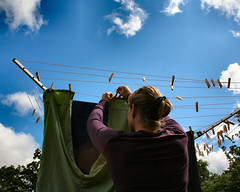 Line-drying your laundry has hit the LA Times, with this article today about "right-to-dry activists and blogging eco-moms... forming an alliance" to make line-drying acceptable and legal everywhere. You can join the fray yourself at Laundrylist.org
I love that there is a catch-phrase for both "right-to-dry activists" and "eco-blogging moms". That means there's enough of us out there to generate some change in this world. And really change, at least in the realm of laundry, is fairly easy to come by. We could cut energy consumption in our country by 6% or more, simply with a string and a few wooden clothespins, or a drying rack or two. It's astonishing in its simplicity.
So go on, be subversive today: Hang your laundry!!!
Tuesday, January 27, 2009
Book Review: You Are Here

I wanted to take a moment to review a book I just read called You Are Here: Exposing the Vital Link Between What We Do and What That Does to Our Planet
I am of mixed feelings about this book. On the one hand, I think the message is a vital one. The author, Thomas M. Kostigen takes journeys to some of the most environmental fragile and ravaged places on the planet. He shows us directly the outcomes of our actions, the actions we take on a daily basis. It's depressing as all hell. If you want to feel like you should just drown yourself in your Yerba Mate', by all means pick up this book. I know the author means really really well, and his most urgent hope is that by reading this we will feel called to act. Unfortunately, he doesn't tie what he's seeing and experience to direct and very real things that each of us can do. He tries to, but this is where the book falls completely flat.
In some places, he makes sweeping pronouncements that most anyone who would buy this book probably already knows, like "We've yet to realize that the global village people have talked about is for so long is here. Now the question is, how do we all live together and make the best of it?"
In other places, he offers us vague and unachievable aims like "With an oil palm sustainability label on products, consumers could make informed choices about the products they eat and/or buy at the supermarket. It's these types of solutions that will make the difference" So, how exactly am I supposed to get such a label on products, how does that "expose the vital link" between my actions and the outcome (deforestation in Borneo due to palm oil plantations).
But my biggest beef with this book is the shoddy quality of the writing. God, are there no book editors left on this planet?
Check out this "paragraph" for an example:
From an environmental perspective, the past is the best measure of things to come. It always has been. Certain weather cycles exist as they have for centuries. Certain wind patterns occur at the same time each year. On a very basic level, the change of seasons informs us of temperature changes because we've experienced those seasons before. Think about the first time someone lived through winter. I bet the next year they buttoned up.
I dare you to give me the author's theme for that paragraph! What the heck is he trying to say? is something I asked myself frequently while reading this book. Sometimes I had to go back and read a paragraph over to make sense out of it.
Here's another example:
Still, exaggeration and alarmism are too frequent in environmental writings. Like everything, the conditions that plague Mumbai are complicated and consist of many factors, not just one or a few. We are, after all, talking about a society that has existed for five thousands years. But there are parallels and there are consequences, which are very real. We can take preventative steps -- even little ones count.
If not for the political slant of this book, I would wonder if it was ghost written by George W. Bush, so convoluted and confusticating is the prose. And after that last little homily about little steps counting, the author fails to name even one that we could take, to avoid whatever he's talking about in Mumbai. Instead, he jumps right on to another subject.
All in all, this book shows some interesting things. The author has taken bold steps to visit logging camps in Borneo or remote villages in Alaska that are sliding into the sea. But aside from making us all want to slit our wrists in depression, he accomplishes nothing whatsoever with this journey that he takes us on. What I would love to see is real actions tied to the horrific environmental catastrophes that he takes us to.
Bottom line: not recommended. Treehugging, spotted-owl-saving, recycling liberals will be depressed and non-liberals will just be confused.
Thursday, January 15, 2009
The Out-Of-Time Laundry Approach
 We're crazy-busy right now with our robotics team going to the State Championships this weekend in Hillsboro. I'm probably the crazy-busiest of all, given that I'm
 A) The Mom
and
B) The Coach.
Poor Wayne just had hernia surgery, so he's not really able to be helpful in any meaningful sense, except for offering suggestions about things that I could be doing. And...um...that's not really helpful. So everything falls on me right now - dishes, food, sweeping, laundry, yadda yadda yadda. The nice thing about having kids this age is that they can pitch in a lot and really help out. There's nothing like being able to say "Could you please go clean the bathroom" and actually having it look clean afterwards (even the toilet!)
Laundry is perhaps the biggest time-killer, especially if you're trying to hang it all out to dry, especially in this damp and cold season when it can take a couple of days to do so. These are the times I'm especially tempted to just fall back on technology and fossil fuels and throw it all in the dryer for an hour or two of spinning heat. But I hit upon a solution that's a good compromise between this and laundry martyrdom. I run a load of laundry, then I take the heaviest slowest-to-dry items and put them in the dryer, but I don't run it yet. I get another load started in the washer and hang the quickest-to-dry items (like my polypro running gear) in the bathroom over the heater vent. The rest goes on the drying racks in the garage. I repeat this with load two and perhaps even a load three. By the time the last load is done, I have a full dryer and I run it with the heavy stuff. So I do use the dryer, but for one load out of three. My laundry work-time is cut at least by 30%, and that lands it in the "manageable" category. That's my out-of-time tip for the day.
Tuesday, January 06, 2009
Some Great Reading
Here's an excellent post on the No Impact Man blog about heating houses, sustainability, choices, and what it means to "Gaman" ("endure," or "tolerate") in Japanese culture.
Tuesday, December 09, 2008
Crying Over Spilt Milk
 You know the old saying "don't cry over spilt milk"?? That one never made sense to me when I was a kid. I mean, you spill some milk, so what? You clean it up, you go to the store and get another gallon of milk. Big deal.
Now that we're getting our milk locally and only once a week, I would certainly cry if we spilled one of our precious half gallons. As it is, if we use some for one thing, we have to go a little short on something else. Of course, we've still got the option of going to the store and getting some cow's milk for Wayne and I to drink (only the kids are allergic and need the goat's milk), and luckily for us we can actually get local, organic cow's milk in glass bottles at our corner market. People who invented the saying about crying over spilled milk I'm sure didn't have that option. They had whatever came out of the cow, goat, or sheep that day, and that was it.
Now that it's winter and our hens aren't laying as much, eggs are another precious commodity. I dropped one a couple of nights ago coming back from the chicken coop and knew that meant one less egg for breakfast. It may seem archaic to live from hen or goat to mouth as it were, but I also think it brings with it a much greater appreciation of both your food and its source.
Mackenzie just read Old Yeller and its sequel Savage Sam. The picture of pioneer life it paints shows just how tenuous their hold on basic survival was. Their food for the winter depended on keeping the raccoons and skunks out of their corn patch and the wild animals away from their drying salted meat. Any excess milk had to be made into cheese or butter or it couldn't be kept.
I also just finished reading Life As We Knew It, which will really get you to thinking about all the conveniences of modern life, and how well you would cope if they all suddenly disappeared. Would you be making do, or crying over spilt milk? It's a reasonable read if you're interested in how the world might cope without its current transportation system (though that's not really the theme of the book or anything).
Wednesday, December 03, 2008
Local Meal, Dark Days Challenge

Since my computer crash, it's been hard for me to get time to post about our local eating, but we're still doing the Dark Days Challenge here. Our Thanksgiving wasn't a 90% local meal, but we did try to incorporate a lot of local foods into our Thanksgiving dinner. The best surprise from that was that when you use really great ripe, fresh local cranberries then cranberry sauce tastes AMAZING. It's nothing like that stuff you get in a can, or even the stuff I've made from scratch before. Luckily, Oregon is a major grower of cranberries, not too far from here on the coast. Unfortunately, our local supermarket (who used to be better about showcasing local growers) had bags of Ocean Spray cranberries from Vermont out on their Thanksgiving display! I had to ask where the local cranberries were, and I was so glad that I did. They were wonderful. We also had local greens and veggies, and I made a pumpkin pie from scratch with pumpkins from our garden, cream from our local raw goat's milk, and eggs from our own chickens. The kids proclaimed it the best pumpkin pie ever!
 So on to our local meal for this week. I decided to make San Francisco Stew, a recipe from my grandma, it's like a savory chili with some bacon and brown sugar. We're quite lucky here as it's very easy to source a lot of local foods. Our small corner grocery that's a few blocks away sells local grass-pastured ground beef, so I picked up a pound of that. We buy a 1/3 of a pig each year and have it butchered, so that takes care of the bacon.
  I was fortunate enough to get in on a bulk order of dried pinto beans a couple of months ago. They're local and transitional organic. Still, they have a fair bit of dirt and rocks included, so first Asa had fun sorting beans from rocks. Then we brought them to a boil and then let them soak overnight.
 At our karate dojo, someone brought in a basket of onions and garlic from their garden for free, so those were chopped up and cooked up with the ground beef and bacon.
 Last month, my mom told me that if I gathered in all of the green tomatoes from my garden and individually wrapped each one in newspaper and kept them cool, they'd ripen up on their own. So I unwrapped all of my tomatoes and lo and behold had some gorgeous red ones from my own garden. Those went into a pot to boil down into tomato sauce for the stew base.
 To this I added the only non-local ingredients: salt, pepper, and some brown sugar (there aren't many local sugarcane sources in the Pacific Northwest! though I might experiment with substituting honey in the recipe in the future).
 Along with the stew, we had peppers and purple carrots from our garden (the last of the peppers, but I still have a few more carrots left), and for dessert some yummy homemade applesauce from some windfall apples that my neighbor said I could glean from their trees.
 With all of the various ingredients that we were able to grow, glean, trade, or buy locally, I'd say this meal was about 99% local, very cool! I love that this challenge really got me thinking about what I could use from around here.
My Unofficial Bike Count

While gas prices continue to plummet (fortunately at least signalling that we're collectively using less of the stuff), I have been surprised to note that the number of bike commuters has remained relatively high. Even as we head into December and the colder and wetter weather that comes with the winter months, I have noticed an unusually high number of bike commuters on my regular routes.
I usually keep my own personal tally as I commute to work, and as I bike home from the gym in the morning. Two years ago, it was typical to see about 10 - 15 cyclists on my 2.5 mile route (one way). This year, it's about doubled to an average of 32. That's more than one cyclist per block on my route!
Saturday, April 05, 2008
The Beauty of Instinct
Not too long ago, we had a very cold and blustery day around here. It was so windy, the gate to the chicken coop blew shut, and when I went to put the chickens up for the night, only five of them were in the coop. So I went out to look around the bigger enclosure and couldn't see them at all. Now, if you know how much like pets these chickens are, you can imagine my terror in thinking that several of them had been eaten by one of the local raccoons or killed by another dog or some other such terrible fate. I went back up to the house for a flashlight and took a closer look around the pen, when I finally spotted them.
There's an oil barrel up against the back wall of the chicken coop, and all five of the chickens had somehow managed to wedge themselves into the space between the barrel and the wall. They were stacked on top of each other, and this space is about the only place in the enclosure with a roof over it, so they were even mostly dry from the rain. When I picked up each of the hens to carry them back to the coop, they were dry and toasty warm from being all stacked up like that. The funny thing about chickens is that when it's dark, they shut down like little robots that have been switched off. I couldn't even get them to walk up into the coop, so I had to stuff them through the coop door one at a time. Once in the light of the coop, they finally woke up enough to flap up to their perch.
I've noticed some other instinctual things about the chickens, like how they're all silent and still on their perch when I go to close the coop up at night, but as soon as the door is closed and they're secure, they all hop down from the perch and go to get some food or water. But until that moment of safety, they all remain perfectly still, you wouldn't even know there were chickens in the building at all from the quietness within.
Now I know chickens are almost as dumb as the boards they perch on. If they're out in the big enclosure and one of them goes back into the little pen, they often can't figure out how to get back out again. The door is, of course, in the same position it's always been in, but they don't seem to remember. They'll pace all around the cage with an expression like "how did that other chicken get out there?". But they have their instincts, and those instincts are pretty good at preserving them in many circumstances.
People, on the other hand, have lots of brains - tons and tons of grey matter that lets them think about all kinds of interesting stuff. But our instincts for self-preservation and benefiting our flock are just about zero. It seems like every day there's another news article that shows that what the "extremeists" have been saying all along (about the energy crisis, global warming, blah blah blah) is probably going to look like a picnic compared to what's really going to go down. Wheat shortages, rainforest mowed over for biofuels, ice melting and sea levels rising, gas prices soaring, jobs diminishing, the "recession" that no one wants to call a recession looming over everyone's heads. A woman (who commutes 90 miles a day) interviewed in an article about rising gas prices says she'll have to cut back on her Starbucks to save money for gas, politicians continue to talk about biofuels as if they'll save us, no one at all mentions the big "C" word - Conservation.
We're headed for the abyss, and unlike a sensible chicken we still fail to do the right thing.
There's an oil barrel up against the back wall of the chicken coop, and all five of the chickens had somehow managed to wedge themselves into the space between the barrel and the wall. They were stacked on top of each other, and this space is about the only place in the enclosure with a roof over it, so they were even mostly dry from the rain. When I picked up each of the hens to carry them back to the coop, they were dry and toasty warm from being all stacked up like that. The funny thing about chickens is that when it's dark, they shut down like little robots that have been switched off. I couldn't even get them to walk up into the coop, so I had to stuff them through the coop door one at a time. Once in the light of the coop, they finally woke up enough to flap up to their perch.
I've noticed some other instinctual things about the chickens, like how they're all silent and still on their perch when I go to close the coop up at night, but as soon as the door is closed and they're secure, they all hop down from the perch and go to get some food or water. But until that moment of safety, they all remain perfectly still, you wouldn't even know there were chickens in the building at all from the quietness within.
Now I know chickens are almost as dumb as the boards they perch on. If they're out in the big enclosure and one of them goes back into the little pen, they often can't figure out how to get back out again. The door is, of course, in the same position it's always been in, but they don't seem to remember. They'll pace all around the cage with an expression like "how did that other chicken get out there?". But they have their instincts, and those instincts are pretty good at preserving them in many circumstances.
People, on the other hand, have lots of brains - tons and tons of grey matter that lets them think about all kinds of interesting stuff. But our instincts for self-preservation and benefiting our flock are just about zero. It seems like every day there's another news article that shows that what the "extremeists" have been saying all along (about the energy crisis, global warming, blah blah blah) is probably going to look like a picnic compared to what's really going to go down. Wheat shortages, rainforest mowed over for biofuels, ice melting and sea levels rising, gas prices soaring, jobs diminishing, the "recession" that no one wants to call a recession looming over everyone's heads. A woman (who commutes 90 miles a day) interviewed in an article about rising gas prices says she'll have to cut back on her Starbucks to save money for gas, politicians continue to talk about biofuels as if they'll save us, no one at all mentions the big "C" word - Conservation.
We're headed for the abyss, and unlike a sensible chicken we still fail to do the right thing.
Wednesday, March 05, 2008
It All Adds Up
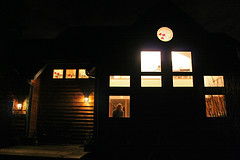
Not too long ago, we started looking over our energy bills for the past year. One year ago, we had a renter in our basement apartment (a 650 sq foot "mother-in-law" unit). This has been our first opportunity to compare our current energy bills from those of the same season when we had the apartment rented. What we discovered was pretty darn interesting. Our utility bill is half of what it was when we had our renter living downstairs. Yep, four people in a 1670 sq foot house upstairs use about the same amount of energy as one person in the apartment downstairs. I've always been a mite suspicious of those carbon footprint calculators on the web (although I think they're a great tool for raising awareness), because they typically make assumptions about our energy use based on our house and number of people living here. This is the first time I've had solid proof that energy-efficient everyday living practices can make a huge difference in how much energy we use.
The things we do are pretty simple - our house gets great natural light during the day, so we don't use interior lighting in daylight hours. At night, we turn off lights as soon as we leave a room. We turn off and/or unplug appliances that we aren't using. We try to use energy wisely (like making an entire pot of tea instead of once cup at a time). We hang clothes out to dry instead of using the clothes dryer, and open the dishwasher before it enters the drying cycle. Our clothes washer is an efficient front-loader that does a ton of laundry in one batch. We conserve water in other ways, like turning the shower on halfway instead of on full, and we set our thermostat to 58 in the winter (using a heat pump) and don't use air conditioning in the summer. Probably our biggest energy drain is our chest freezer, but that gives us the ability to buy local organic pastured meats, and store all of the berries and other fruits and veggies we grow and glean during the summer.
None of these things are particularly difficult or odious. We don't really feel deprived. We aren't living in left-field, or god forbid not showering to save water. Patchouli never enters our house and none of us particularly likes granola. But the little things do add up. Every year we try to add a few more of them to our pile of little sustainability stones. This last year we bought honeycomb blinds for many of the windows, especially the ones that get a lot of sun in the summer. Next year we'll try to add some more to the other windows. We're hoping that a homemade solar hot water heater is in the works for us sometime soon. We implemented the garage clothes-drying racks this winter which drastically reduced the amount we use the clothes dryer in this wet season. We changed out even more bulbs to CFLs. Incidentally, all of the light in the photo at the top of this post comes from two flourescents that are our main indoor lighting. We've changed them only once since we moved in eight years ago, now that's what I call efficient!
I'm excited to learn that all of our little efforts add up. I have friends, both on-line and in real life who are living the ultimate energy efficient lifestyles in off-the-grid or Net Zero homes. Right now, that's not in the cards for us, but it's great to know that making these smaller efforts can have a huge impact on our energy usage, and thus on our carbon footprint and overall environmental impact. I like to think that if regular ol' folks knew what a difference they could make (a family of four using less energy than one person!), they might be inspired to implement a few more changes themselves.
Tuesday, February 19, 2008
Reducing Garbage, Part 1
 A while back, someone on a list I'm on asked for tips on reducing garbage. I've been meaning to write about it for awhile, and every now and then a new idea pops into my head and I jot it down somewhere. It's amazing how little garbage you can produce, once you really become aware of what you throw away and start working on reducing it. We get the smallest can that our garbage company gives out, and we've shared it with our renter and the family across the street and had room left over. One thing you can start doing is becoming aware of what you're throwing away. You don't have to dig through the trash, but just look at it when you toss something else in and think about whether that thing could be eliminated, substituted, recycled, or composted. I'm sure this is far from a comprehensive list, but here's a few ideas at least...
1) Compost: One of the first steps you can take is to stop throwing away food scraps. Compost piles can range from big wire-enclosed areas, to small portable worm bins. Turning your food scraps into gardening soil is a great first step at garbage reduction. Resources for Composting and Worm Bins abound on the internet, and in many cases in your local community. There's even a worm bin specifically designed to turn your pet waste into usable compost, thus keeping it out of the landfill as well.
2) Return to Cloth: Perhaps the easiest thing to remove from your garbage is anything disposable - napkins, paper towels, baby wipes, kleenex, diapers, etc. These used to be the main culprits, but the past few years have seen a veritable explosion in the disposable market, with everything from bibs to facial washcloths, to Swiffer mops being produced just to be used once and thrown away. One of the easiest ways to stop throwing this kind of stuff in the trash is simply to stop buying it. Once I stopped buying paper napkins, I had to have something else in place to use. I started adding to my small supply of cloth napkins (and actually I used washcloths for awhile until I had a big enough stash). I found that if I had a roll of paper towels or a paper napkin handy, it was easy to reach for them. Without them around, you simply don't use them. I do keep a roll of paper towels in the garage for use in times of desperate measures (the cat just barfed on the carpet, that kind of thing), but I haven't bought a new roll since we moved into this house 8 years ago, so they last a long time that way. Cloth diapers, handkerchiefs, washcloths, mop covers, napkins, and bibs are long-lasting and relatively easy to toss in the washing machine (even the diapers weren't as icky and intimidating as I thought they'd be before having babies).
 3) Look For Less Packaging: Often we don't have the option of buying something with less packaging - it seems like you need a pair of gardening shears and an expert safe-cracker just to get into the packaging for your basic CD these days. But often we have an option to buy something with less packaging or substitute something reusable. Rechargeable batteries for instance, not only save you from having to dispose of toxic batteries, but also all the packaging that they come in. Buying meat locally means that it comes straight from the butcher wrapped in white paper, instead of resting on styrofoam trays. Buying produce locally avoids those nasty plastic clamshells that are becoming popular in places like Trader Joe's, and if you can swing it to get stuff like milk and eggs from a local source, you can also eliminate egg and milk cartons from your garbage stream and re-use glass bottles instead. Even if you don't have a direct source, there are still local dairies that use and re-use glass bottles (usually with a deposit).
4) Borrow, Barter, Buy Used: If you need to buy something, you can think about whether or not it's something you can borrow, or barter for, or buy used first. Not buying stuff new eliminates packaging, transportation, and possibly having to deal with the remains of whatever you've bought. If you think about it, there's usually no reason for every person on the block to have a hedge trimmer, or a particular best-selling book, or even a pickup truck. Sharing with neighbors or friends is a bonus to all (including the environment). Our chicken tractor is on its way to the 3rd family we've lent it to. Our power-washer has made the rounds of every deck and fence in the neighborhood, and we've borrowed our neighbor's truck or trailer when we needed to haul something. Our daughter is clothed entirely in wonderful hand-me-downs from the neighbor girl down the street, and the clothes keep right on flowing from her to a smaller friend a few blocks away. Thinking outside the box when it comes to consumer goods is also a great way to boost your budget, while reducing your impact on your garbage can and the earth.
Wednesday, February 06, 2008
Bits and Blurbs
 If we ever end up needing a really great commuter car, here's one, the Aptera, I've got my eye on:
 I just read an article about it and they said that in track tests it has been exceeding their expectations, topping out around 300 mpg in some cases! Message to Detroit, hello! Is anyone listening???
And I have to say, I'm pretty excited about yesterday's primaries here in the U.S. (though in Orygun, we won't be voting until May. May!). I'm pretty strongly in the Obama camp, largely on account of his stances on the war and his environmental scorecard from the League of Conservation Voters (highest among all the Dems). It doesn't hurt at all that he is inspiring hope for the first time in a long time among people disenfranchised from our current political system:
Subscribe to:
Posts (Atom)


