Thankfully my family watched a movie in the basement the other night. And also thankfully my husband fell asleep downstairs and I wisely decided to not disturb him to come up to bed. I say thankfully because that was the night our hot water heater decided to give up the ghost and start leaking gobs of rusty water all over the place. My light-sleeping hubby managed to get up and turn off the water, mop everything up (albeit with some nice bath towels that are now destined for the dustbin), and avert a total disaster. But now we need a new hot water heater.
For years, we've been looking longingly at the tankless or on-demand systems. We first encountered them in Tanzania over a decade ago and wondered why we'd never seen anything so smart in the USA. Over here, we apparently think it's a good idea to keep warming gigantic tanks of water and expend electricity to keep them warm even when no one is using them. Eventually, we saw some gas on-demand heaters come out, but our house isn't hooked up to gas and we don't really want to do so. Now they have electric tankless water heaters that will manage enough water volume for a whole house, so that's what we're researching today. It's not an expenditure we were planning on making right now, but since opportunity has presented itself, it's a good time to get more energy efficient. Many of the new heaters will also work well with a solar hot water system when we eventually get one, so that's a big bonus as well.
Thursday, March 08, 2007


Friday, March 02, 2007
Not Much Cuter Than New Chicks

We got our new layer chicks this week, and there's not too many things cuter on this earth than holding a new little baby puffball in your hands. We all got to pick out a couple, so we have Aracaunas, Black Sexlinks, a Blue Andalusian and a Brown Leghorn. Should be an interesting mix of chickens! The peepers are out in the garage for now with a heat light, and I need to get our old chicken tractor back from a friend to use when they get bigger, until they're ready to join the older ladies in the coop.
I'm glad that the chicks arrived at our Feed-n-Seed store, because it's been a dark week otherwise. We had to put our beloved 14 year old dog Sabre to sleep this week. Even as old and gimpy as he was at the end, he always got up in the morning and evening to check the chickens with me. He was a shepherd through and through, and his working dog ethic never failed. Even after our other chickens were attacked by the neighbor's dog, they were never afraid of Sabre. He was a gentle and sweet soul, and we will really miss him. I've been having a pretty hard week of it, and posted some on my other blog about all of that. My husband gave me Sabre in the first year after we met, so he's been with us for our entire married life, and the kids have known him through their whole lives too. He went everywhere and did everything with us, so there's a pretty big hole in our lives right now. I know it will get easier with time.
In other good news, stay tuned for some possibly exciting news about our solar panels!
Wednesday, February 21, 2007
Being Fit and Energy Consumption
We had a guy from the local Heating company over last week to look at our heat pump. We're considering getting it replaced with a more efficient (and quieter!) model at some point, and wanted him to evaluate our whole system and how it was working for the house. We did get some great information about new energy efficient models of heat pumps and air circulators, and we'll be putting that on the list of things we'd like to upgrade when time/money becomes available to do so (also on the list: solar panels, solar greenhouse, rainwater storage system... the list goes on).
The heating guy told us something interesting though, while he was here. We talked about our current heat pump usage and mentioned that we keep our thermostat set at 58 - 60 degrees and he said that we could only really do that because we are all very fit and healthy people in this family. Because we all exercise regularly, our metabolisms run at a fairly high rate, keeping us warmer than more sedentary humans. When we do something sedentary like watching a movie together in the evenings, we bundle under the blankets and keep warm that way.
It's always interesting to me how everything goes in circles. We eat healthy, which makes it possible for us to have lots of energy. Because we have lots of energy, we can lead very active lifestyles. Because we have sustainability as a goal, we tend to bicycle and walk a lot, and we garden and work outside as well. This in turn makes us healthier, more resistant to disease, and even allows us to keep our thermostat lower, which saves us money and furthers our goals of sustainability and using our resources wisely. It all comes around.
So here's to a daily walk or bike ride, keep those (internal human) fires burning!
The heating guy told us something interesting though, while he was here. We talked about our current heat pump usage and mentioned that we keep our thermostat set at 58 - 60 degrees and he said that we could only really do that because we are all very fit and healthy people in this family. Because we all exercise regularly, our metabolisms run at a fairly high rate, keeping us warmer than more sedentary humans. When we do something sedentary like watching a movie together in the evenings, we bundle under the blankets and keep warm that way.
It's always interesting to me how everything goes in circles. We eat healthy, which makes it possible for us to have lots of energy. Because we have lots of energy, we can lead very active lifestyles. Because we have sustainability as a goal, we tend to bicycle and walk a lot, and we garden and work outside as well. This in turn makes us healthier, more resistant to disease, and even allows us to keep our thermostat lower, which saves us money and furthers our goals of sustainability and using our resources wisely. It all comes around.
So here's to a daily walk or bike ride, keep those (internal human) fires burning!
Tuesday, February 13, 2007
Feels Like Spring: Time for Big Plans
We've had unseasonably warm weather here, and spring fever is setting in. The seed catalogs have arrived, I've got new bulbs in the ground, my husband built up our garden boxes so they can be deeper for this year's garden, and I've got about half of the massive leaf pile moved off of our second garden space. We're also hoping to build a solar greenhouse addition on to the front of our house this year, giving us some indoor gardening and seed-starting space, some passive solar heating, and an entryway/solarium to enjoy on those cold winter days.
In the next six weeks, we should also be getting some baby chicks to fill out our flock again, and the kids are very excited about that. Now the sun is shining and it's time to go muck out the chicken coop (one of my least favorite jobs) and move some more leaves.
In the next six weeks, we should also be getting some baby chicks to fill out our flock again, and the kids are very excited about that. Now the sun is shining and it's time to go muck out the chicken coop (one of my least favorite jobs) and move some more leaves.
Friday, February 02, 2007
When Values Collide
The other day was beautifully sunny and almost warm (if you didn't stand in the shade too long). The kids wanted to go to the park with some friends. However, their friends couldn't make it unless we drove (some had parents who were busy, others don't have a car and didn't want to bike). My kids didn't mind biking, but really wanted their friends there and didn't really want to hang out at the park without them. Thus begins yet another dilemma where the values of sustainability and meeting my kids needs and desires collide. There are many such times: when my son wants that new cool Lego set, or there's a great exhibit at the science museum a hundred miles away, a toy that can only be found in The Big Box Store That Shall Not be Named, or a desire for red licorice, a food containing almost nothing but artificially colored high fructose corn syrup.
Recently, on a discussion list, a parent-to-be was detailing their plans for living sustainably on a farm with their (future) kids, raising dairy goats and creating wooden toys that their children would delight in playing with. I was swept with a feeling of nostalgia because I remember clearly our own dreams and how neatly they played out in the imagination and planning, yet how incredibly complex they are to implement in reality. One of the great gifts that children bring to your life is the knowledge that most of what you thought was absolute is, in fact, malleable.
When we were pregnant with our first child, we lived on four acres of beautiful land in Washington state. In my mind, the kids would romp around our acreage and play with natural toys and make tree forts while I blissfully smiled over them while weeding in my organic garden or writing. Except that when the kids came along, we discovered that they had different plans for us.
Our kids are extremely gregarious. They're extremely active. They wanted to be part of groups and do activities. Where we were living was very isolated. To get to any other homeschoolers we had to drive 10 - 25 miles. The roads weren't safe for bicycling with kids and no one cycled there. I started being the mom driving the car all day, and my sustainable dream went up in smoke. I had barely any time to garden. The last year we lived there, I had put 20,000 miles on my car just driving 40 or 50 miles most days to take the kids places. Sure, we could've held the kids hostage on the organic farm, but that's not the unschooling lifestyle we had chosen, it's about helping our kids explore the world and explore their passions. So we picked up and moved. We now live right in a city, something I thought I would not be doing (I'm a born and bred country girl), but we can walk and bike everywhere. The kids are busier than ever, visiting their unschooling friends, being active in all the things they love to do. We managed to find a house with a semi-forested lot next door that was undeveloped, so we have a small bit of our dream, but we can't have the horses and goats I envisioned.
The bottom line is that for us, all of our dreams and passions in our family are important, not just those of the adults. That means finding balance between the kids needs and our values, between the kids activities and time for things we want to do, between busy time and quiet time, nutritious foods and red licorice. And yes, I drove the van to the park that day, but then bicycled to work myself that evening. It's all about the balance.
Recently, on a discussion list, a parent-to-be was detailing their plans for living sustainably on a farm with their (future) kids, raising dairy goats and creating wooden toys that their children would delight in playing with. I was swept with a feeling of nostalgia because I remember clearly our own dreams and how neatly they played out in the imagination and planning, yet how incredibly complex they are to implement in reality. One of the great gifts that children bring to your life is the knowledge that most of what you thought was absolute is, in fact, malleable.
When we were pregnant with our first child, we lived on four acres of beautiful land in Washington state. In my mind, the kids would romp around our acreage and play with natural toys and make tree forts while I blissfully smiled over them while weeding in my organic garden or writing. Except that when the kids came along, we discovered that they had different plans for us.
Our kids are extremely gregarious. They're extremely active. They wanted to be part of groups and do activities. Where we were living was very isolated. To get to any other homeschoolers we had to drive 10 - 25 miles. The roads weren't safe for bicycling with kids and no one cycled there. I started being the mom driving the car all day, and my sustainable dream went up in smoke. I had barely any time to garden. The last year we lived there, I had put 20,000 miles on my car just driving 40 or 50 miles most days to take the kids places. Sure, we could've held the kids hostage on the organic farm, but that's not the unschooling lifestyle we had chosen, it's about helping our kids explore the world and explore their passions. So we picked up and moved. We now live right in a city, something I thought I would not be doing (I'm a born and bred country girl), but we can walk and bike everywhere. The kids are busier than ever, visiting their unschooling friends, being active in all the things they love to do. We managed to find a house with a semi-forested lot next door that was undeveloped, so we have a small bit of our dream, but we can't have the horses and goats I envisioned.
The bottom line is that for us, all of our dreams and passions in our family are important, not just those of the adults. That means finding balance between the kids needs and our values, between the kids activities and time for things we want to do, between busy time and quiet time, nutritious foods and red licorice. And yes, I drove the van to the park that day, but then bicycled to work myself that evening. It's all about the balance.
Sunday, January 28, 2007
Now That's An Omelette

Since we're down to only two chickens, I've had to use storebought eggs a lot more this year. While I always use free-ranging organic eggs, after reading The Omnivore's Dilemma, I'm not under any impression that they are actually from real free-ranging chickens (as in running around outside, as opposed to simply not being in tightly confined cages). They used to seem just fine, and compared to the anemic, pale and flabby regular white eggs from abused and confined chickens, they're definitely a remarkable step up. But they're still nothing like eggs from our own chickens.
Today I had a few eggs from our own chickens to make this omelette with and wow, look at the color! I wish I'd taken a photo of one from the store eggs because it's so strikingly different. And you can hardly get the yolks from our chicken eggs to collapse, they're so firm you have to poke them repeatedly with a fork. Chickens fed on grass (like our little lawnmowers) have the highest levels of Omega-3s in their eggs, so I'm not surprised our eggs are so lovely. By comparison, the regular mass-produced, production agriculture chicken egg that most Americans buy has an Omega-6 to Omega-3 fatty acid ratio of 20:1. Professional dietitians recommend a ratio of 1:1 and definitely no higher than 4:1, Omega-6 to Omega-3 fatty acids. Now that's scary: 20:1!!
These days, with so few chickens, I usually save the eggs from our own ladies for the kids to eat, and do my best to get local eggs (which are hard to find and much in demand) or the "free-range Omega-3" eggs from the store for us adults. Still, I'm really looking forward to the day when we have a big flock of layers again and plentiful beautiful yellow eggs for all of us.
Thursday, January 25, 2007
First Time Playing Tag

I've been tagged by Jenny at Ironwood Farm. I'm supposed to list six weird things about me, then tag six people. This is going to be tough, because anyone who knows me knows that my life so far has been far from normal. You know, narrowing all those oddities down to only six might take some serious thought. Here goes:
1. I once lived in a beer vat
2. I have a legendary ability to endure pain (so much so that I worried I wouldn't know when I was going into labor with my first child, as it turned out it was a very founded worry)
3. My mother has sung on stage in a chicken suit. My dad has worn a pink tutu in public and danced to "Glow Little Glowworm". My grandma once ran out of gas dressed like a bunny rabbit. (I come from a theatre family and long line of nutcases!)
4. I still have the tattoo from my days as the guitar playing, mohawk-wearing frontwoman for a punk rock band
5. I can see in the dark (I was once pulled over for driving at night with no lights on, and I was still wearing my sunglasses) and can hear bats, flourescent lights, and other high-pitched noises.
6. I can bend all of my fingers at the top knuckle only.
I'm going to tag: Karen, Doc, Cheryl, Wendy, Danielle, and Christy
Monday, January 22, 2007
How to Support Alternative Transportation Even if You Drive
There are times when many of us drive cars, even those who are very dedicated to non-fossil fuel transportation. Our cities, schedules, lives are not set up to run at the pace in which all of society existed before fossil fuels. This makes it difficult to, say, get from a class on one end of town to an activity on the other end in 15 minutes.
And then there are those people who have no intent of getting around in any other way but a car, but are starting to become aware of fossil fuels issues. Climate change is becoming a heavily discussed topic, thanks in no small part to Al Gore's An Inconvenient Truth. Meanwhile, many people who would like to walk or bicycle to work, or take their kids to school in this manner, do not feel that it is safe to do so.
So for all of us who may find themselves in a large, fuel-driven, fast-moving hunk of metal, here's some things you can do to still make your community pedestrian and bicycle friendly:
1. Stop at crosswalks for pedestrians. In my state at least, this is defined as any intersection, whether it has a marked crosswalk or not. Many drivers don't know this. However, even when standing with my kids, even at a marked crosswalk, even in a $#%! school crossing zone, at least 75% of the cars zoom on through the crosswalk without slowing down or stopping.
2. If a pedestrian is crossing the street, don't nudge your car forward on their heels. This feels intimidating and downright frightening to pedestrians, and really folks it's not going to get you to your meeting any quicker. Leave home earlier if time is such a big issue that the five nanoseconds you gain from putting a young child's life in danger is that important to you.
3. Give cyclists plenty of room. Many people say they would be more inclined to bicycle for transportation if they felt safer on the roads. Cars crowding cyclists is a recipe for disaster.
4. Remember that a cyclist in most places is entitled to take up a full lane of traffic. We don't often do that, prefering to be as courteous to drivers as we can. Please give us the same courtesy: if you have to wait behind us for a few seconds in a stretch of road where it's too narrow to get past safely, remember that you could be (legally) waiting behind us the entire time. It is our right to the road, same as yours.
Taking the time to be courteous and safe with pedestrians and cyclists encourages more people to make use of these transportation methods. Really, I wish everyone who could do so was required to walk or bike at least one trip a week. I think if they took the time to see the world from the perspective of a small body relative to large hurtling chunks of metal, they would be safer and more courteous drivers. If for some reason you can't walk or bike, make sure that the streets and sidewalks are safe for those who do.
And then there are those people who have no intent of getting around in any other way but a car, but are starting to become aware of fossil fuels issues. Climate change is becoming a heavily discussed topic, thanks in no small part to Al Gore's An Inconvenient Truth. Meanwhile, many people who would like to walk or bicycle to work, or take their kids to school in this manner, do not feel that it is safe to do so.
So for all of us who may find themselves in a large, fuel-driven, fast-moving hunk of metal, here's some things you can do to still make your community pedestrian and bicycle friendly:
1. Stop at crosswalks for pedestrians. In my state at least, this is defined as any intersection, whether it has a marked crosswalk or not. Many drivers don't know this. However, even when standing with my kids, even at a marked crosswalk, even in a $#%! school crossing zone, at least 75% of the cars zoom on through the crosswalk without slowing down or stopping.
2. If a pedestrian is crossing the street, don't nudge your car forward on their heels. This feels intimidating and downright frightening to pedestrians, and really folks it's not going to get you to your meeting any quicker. Leave home earlier if time is such a big issue that the five nanoseconds you gain from putting a young child's life in danger is that important to you.
3. Give cyclists plenty of room. Many people say they would be more inclined to bicycle for transportation if they felt safer on the roads. Cars crowding cyclists is a recipe for disaster.
4. Remember that a cyclist in most places is entitled to take up a full lane of traffic. We don't often do that, prefering to be as courteous to drivers as we can. Please give us the same courtesy: if you have to wait behind us for a few seconds in a stretch of road where it's too narrow to get past safely, remember that you could be (legally) waiting behind us the entire time. It is our right to the road, same as yours.
Taking the time to be courteous and safe with pedestrians and cyclists encourages more people to make use of these transportation methods. Really, I wish everyone who could do so was required to walk or bike at least one trip a week. I think if they took the time to see the world from the perspective of a small body relative to large hurtling chunks of metal, they would be safer and more courteous drivers. If for some reason you can't walk or bike, make sure that the streets and sidewalks are safe for those who do.
Tuesday, January 16, 2007
Chicken Heroics
I was working in the yard yesterday and had let the ladies out to wander around (they're especially happy when I'm raking on the big leaf pile, because they get to poke around for the bugs I stir up.) After awhile, one of them went back in to the nest box to lay, and the other accompanied her in as she often does. Ten minutes later, I had a worried-looking hen (don't ask me how I knew) at my heels, trying to get my attention. As I turned around, she headed back toward the coop, looking over her shoulder in what I swear was a "follow me" expression. So I followed her back down, where she promptly jumped up into the nest box beside her companion and lay her beak on her friend's back.
I could hear that the other chicken was making some odd sounds every thirty seconds or so, and it seemed as if she was having trouble getting an egg out, so I trooped back up to the house and Googled (I swear) "Chicken egg stuck". That's when I discovered that this is an actual condition called being "egg bound." I had no idea as none of our hens ever had trouble when they started laying (when, apparently, this is much more common). One website mentioned that if chickens are really cold this can be more common, and since the temperature here has been well below freezing, that might've been it. Unfortunately, I also discovered that being egg bound is a serious condition that often results in death. I don't think I could stand it if another chicken died this year, so I was willing to go to heroic lengths to help this one out.
The "surefire cure" recommended on various websites was to give the chicken a warm bath. Now, that's easier said than done and since this is our fiestiest chicken, I had my doubts as to the feasibility of such an endeavor, but when I picked her up she came agreeably enough and we went up to the house and into the bathroom. Ten minutes in a warm bath didn't produce any eggs, but the chicken seemed like she was in a lot less distress at least. There were some funny moments as she looked at herself in the bathroom mirror, trying to figure out where the other chicken was.
According to the chicken experts, I was also supposed to...um... lube up the "vent" area (they actually recommend KY jelly) to facilitate slipperiness and egg expulsion. Here's where I started to feel a bit James Herriot-ish, since I recall he always had a hand up some animal or another. But, being the urban farmwife that I now am, I gave it a try. Fortunately, I could feel the egg right there, so I had a hunch that she'd be okay.
By this time it was getting dark and almost time for me to head to work. My husband didn't want to try carrying the chicken back down (I'm sure he was having flashbacks to the last time he tried to catch a chicken, an act that provided much amusement for the entire neighborhood). But she was far too wet to take out in such cold. The answer? A hair dryer. I never use one, so I had to dig around awhile to find it, but eventually we were blow-drying the chicken (oh I wish I had a photo of this), and could return her to the coop, warm and at least more comfortable.
Within an hour, she'd laid the egg and all's well that ends well. The things that most impressed me from this little escapade were the sweet way that Dingbat (one of our hens) came and got my attention to go help her friend, and how sweet our fiesty little Hera was as I tried to help her. Also, my continuing education as a keeper of chickens and perhaps even Hairdresser to the Poultry World.
I could hear that the other chicken was making some odd sounds every thirty seconds or so, and it seemed as if she was having trouble getting an egg out, so I trooped back up to the house and Googled (I swear) "Chicken egg stuck". That's when I discovered that this is an actual condition called being "egg bound." I had no idea as none of our hens ever had trouble when they started laying (when, apparently, this is much more common). One website mentioned that if chickens are really cold this can be more common, and since the temperature here has been well below freezing, that might've been it. Unfortunately, I also discovered that being egg bound is a serious condition that often results in death. I don't think I could stand it if another chicken died this year, so I was willing to go to heroic lengths to help this one out.
The "surefire cure" recommended on various websites was to give the chicken a warm bath. Now, that's easier said than done and since this is our fiestiest chicken, I had my doubts as to the feasibility of such an endeavor, but when I picked her up she came agreeably enough and we went up to the house and into the bathroom. Ten minutes in a warm bath didn't produce any eggs, but the chicken seemed like she was in a lot less distress at least. There were some funny moments as she looked at herself in the bathroom mirror, trying to figure out where the other chicken was.
According to the chicken experts, I was also supposed to...um... lube up the "vent" area (they actually recommend KY jelly) to facilitate slipperiness and egg expulsion. Here's where I started to feel a bit James Herriot-ish, since I recall he always had a hand up some animal or another. But, being the urban farmwife that I now am, I gave it a try. Fortunately, I could feel the egg right there, so I had a hunch that she'd be okay.
By this time it was getting dark and almost time for me to head to work. My husband didn't want to try carrying the chicken back down (I'm sure he was having flashbacks to the last time he tried to catch a chicken, an act that provided much amusement for the entire neighborhood). But she was far too wet to take out in such cold. The answer? A hair dryer. I never use one, so I had to dig around awhile to find it, but eventually we were blow-drying the chicken (oh I wish I had a photo of this), and could return her to the coop, warm and at least more comfortable.
Within an hour, she'd laid the egg and all's well that ends well. The things that most impressed me from this little escapade were the sweet way that Dingbat (one of our hens) came and got my attention to go help her friend, and how sweet our fiesty little Hera was as I tried to help her. Also, my continuing education as a keeper of chickens and perhaps even Hairdresser to the Poultry World.
Tuesday, January 09, 2007
A River (of Leaves) Runs Through It

The premise is this: take 1/3 acre of property, formerly covered with junk and invasive ivy, one gigantic leaf pile (10 large dump truck loads of leaves), spread leaves evenly over property, hopefully killing or at least weakening ivy and blackberries and enriching the soil. Some of this area will be our second garden, and some will just be fun areas for the kids to romp around in down by the creek, and maybe I'll plant a couple of fruit trees in the sunnier spots. I've been doing an hour or two a day on the leaf pile every day this week since the weather has been balmy. I'm starting to make at least a small dent in it, I've probably moved at least one to two dump truck loads by hand so far, and my hands have the callouses to prove it!
This photo is taken from the top of the leaf pile, showing the river of leaves flowing outward and down the slope. It reminds me a bit of Lava Butte, over by Bend, Oregon. From the top of the butte, you can see the lava flows spiraling outwards just as if they flowed out yesterday.
Saturday, January 06, 2007
The CPC Catalog
When I get catalogs in the mail, I've learned that the absolute best thing for me to do with them is put them straight into the recycling bin (actually, the best is to keep trying to get off the mailing lists, but second best is recycling them). Otherwise, if I start leafing through them, I invariably see something that ten minutes ago I didn't know that I absolutely needed to have. It's the same reason I rarely go to malls, department stores, or big box stores. Who needs to see all that stuff you don't have and probably shouldn't buy?
The kids, unfortunately, have become catalog addicts. Before these bits of mind-sucking consumerism can even make it from counter to recycling, they are flipping the pages relentlessly, only to pause momentarily to utter that chilling phrase: "I want that." The same thing happened when we were on vacation and we watched TV that you couldn't fast forward through the commercials. Every 15 minutes, a chorus of "I want that" would issue forth from the small beings on the hotel bed.
Now, I'm not opposed to the kids getting things that they want and love. Like any unschooling parent, I support their inquisitiveness, their joy in play, and their need to learn what they like and don't like, what lasts and doesn't last, through their own experiences. As an environmentalist though, I have to admit that this is one of those places where values clash. The thought of buying more and more and more new Stuff, undoubtably manufactured in China from the cheapest possible, least-renewable materials by underpayed workers in sweatshop conditions, and then shipped thousands of oil-fueled miles across the ocean sets my treehugging teeth on edge.
One way that I've been able to embrace these two halves of my value system is that we've given the kids their own money to spend. We don't in any way control their money, and they can use it to make a purchase of something they'll love and cherish and play with for years and years, or something that will fall apart the instant it's out of the box. Over the years, they have done some of each of those things.
The kids do, however, ask my opinion, and they know full well my Scale of Toy Quality. On one end are toys with "Sticking Power": the ability to be enjoyed for a long time, the ability to keep engaging one's brain or heart or relationships. Toys that fall under here have been well-loved stuffed animals, Legos, games, puzzles, yo-yos, musical instruments, dolls, and more. On the other end of the scale from Sticking Power is CPC. For those who aren't offended by the occasional colorful word, that stands for Cheap Plastic Crap (or, since my kids abhor curse words, unlike their sailor-mouth mother, "Cheap Plastic Crud). CPC does nicely for short. We've all seen (and dreaded) these toys - they fall apart instantly, they have insufferably small pieces that get lost almost as quickly, or they simply have limited play power and are quickly tired of and relegated to the dregs of the toy bin with a couple of old thrift-store-purchased Happy Meal toys.
Well, today was one of those Dreaded Days, the day when the Oriental Trading Company catalog (a.k.a. Penultimate Catalog of CPC) arrived. The kids leafed through it with the usual oohs and aahs over the five dozen rubber ducks with assorted accessories, and the flashing spiky plastic ball keychain thingamabobbies, but as time goes by, the oohs and aahs are often followed by "But I'm saving my money for that game I really want". It's nice to know that, even though we've never banned the kinds of toys that I personally abhor, they're able to find their way to their own understanding of what matters to them. That doesn't mean we'll never see another "made in China" label, but I think that the chances are ever-increasing that the objects that are brought into our house are things that the kids will love and cherish.
The kids, unfortunately, have become catalog addicts. Before these bits of mind-sucking consumerism can even make it from counter to recycling, they are flipping the pages relentlessly, only to pause momentarily to utter that chilling phrase: "I want that." The same thing happened when we were on vacation and we watched TV that you couldn't fast forward through the commercials. Every 15 minutes, a chorus of "I want that" would issue forth from the small beings on the hotel bed.
Now, I'm not opposed to the kids getting things that they want and love. Like any unschooling parent, I support their inquisitiveness, their joy in play, and their need to learn what they like and don't like, what lasts and doesn't last, through their own experiences. As an environmentalist though, I have to admit that this is one of those places where values clash. The thought of buying more and more and more new Stuff, undoubtably manufactured in China from the cheapest possible, least-renewable materials by underpayed workers in sweatshop conditions, and then shipped thousands of oil-fueled miles across the ocean sets my treehugging teeth on edge.
One way that I've been able to embrace these two halves of my value system is that we've given the kids their own money to spend. We don't in any way control their money, and they can use it to make a purchase of something they'll love and cherish and play with for years and years, or something that will fall apart the instant it's out of the box. Over the years, they have done some of each of those things.
The kids do, however, ask my opinion, and they know full well my Scale of Toy Quality. On one end are toys with "Sticking Power": the ability to be enjoyed for a long time, the ability to keep engaging one's brain or heart or relationships. Toys that fall under here have been well-loved stuffed animals, Legos, games, puzzles, yo-yos, musical instruments, dolls, and more. On the other end of the scale from Sticking Power is CPC. For those who aren't offended by the occasional colorful word, that stands for Cheap Plastic Crap (or, since my kids abhor curse words, unlike their sailor-mouth mother, "Cheap Plastic Crud). CPC does nicely for short. We've all seen (and dreaded) these toys - they fall apart instantly, they have insufferably small pieces that get lost almost as quickly, or they simply have limited play power and are quickly tired of and relegated to the dregs of the toy bin with a couple of old thrift-store-purchased Happy Meal toys.
Well, today was one of those Dreaded Days, the day when the Oriental Trading Company catalog (a.k.a. Penultimate Catalog of CPC) arrived. The kids leafed through it with the usual oohs and aahs over the five dozen rubber ducks with assorted accessories, and the flashing spiky plastic ball keychain thingamabobbies, but as time goes by, the oohs and aahs are often followed by "But I'm saving my money for that game I really want". It's nice to know that, even though we've never banned the kinds of toys that I personally abhor, they're able to find their way to their own understanding of what matters to them. That doesn't mean we'll never see another "made in China" label, but I think that the chances are ever-increasing that the objects that are brought into our house are things that the kids will love and cherish.
Tuesday, January 02, 2007
You Don't Need a Weatherman
Although An Inconvenient Truth came out awhile ago, it seems that the effect is still rippling out in impacts small and large. In several different conversations this week, people have mentioned the movie in the context of things they are doing differently. With the November elections just barely behind us, and the presidential contenders just starting to ramp up, it feels like the weather is finally changing across the USA - you can almost feel the wind blowing from another direction. Here's hoping it's a strong and steady wind, one that will bring real and lasting change.
I sometimes think about all of the little things that we can do, things that are not so very difficult and seem like a drop in the bucket. But if every person chose to do them, the impact would be huge. We've seen this with changes that are already happening. Recycling is a frequently quoted example. It took awhile to get the ball rolling, but now enough people are doing it to make a real difference. If everyone took one car-free day a week, gas consumption and emissions would drop dramatically. Or made a commitment to buy one food locally that they now purchase from a regular store. Or turned their thermostat down two degrees, a barely noticeable amount, took one minute less in the shower, turned off lights they weren't using, installed compact flourescents or energy-saving blinds.
In 2007, I have some very broad goals in mind for sustainability, and some very specific things too. Some of my specifics are:
- One car-free day a week (or more) in the winter, two or more in the summer.
- Drive 500 fewer gas-fueled miles than last year (this has been a goal of mine - that I've met! - for the last few years)
- Join a CSA
- Shop at the Farmer's market every Tuesday in the summer
- Get another set of chicks in the spring, so we can have more home-grown eggs again
- Find a local source for cow's milk
- Glean more fruits and nuts in the fall
- Start canning again this fall
- Another degree down on the thermostat (we've gone from 67 five years ago to 60 now)
- Bring disposable gloves in the car for picking up garbage at beaches and campsites
As we all make New Year's resolutions this time of year, I hope we are all thinking of not just goals for ourselves and our families, but for our planet and its diminishing resources as well.
I sometimes think about all of the little things that we can do, things that are not so very difficult and seem like a drop in the bucket. But if every person chose to do them, the impact would be huge. We've seen this with changes that are already happening. Recycling is a frequently quoted example. It took awhile to get the ball rolling, but now enough people are doing it to make a real difference. If everyone took one car-free day a week, gas consumption and emissions would drop dramatically. Or made a commitment to buy one food locally that they now purchase from a regular store. Or turned their thermostat down two degrees, a barely noticeable amount, took one minute less in the shower, turned off lights they weren't using, installed compact flourescents or energy-saving blinds.
In 2007, I have some very broad goals in mind for sustainability, and some very specific things too. Some of my specifics are:
- One car-free day a week (or more) in the winter, two or more in the summer.
- Drive 500 fewer gas-fueled miles than last year (this has been a goal of mine - that I've met! - for the last few years)
- Join a CSA
- Shop at the Farmer's market every Tuesday in the summer
- Get another set of chicks in the spring, so we can have more home-grown eggs again
- Find a local source for cow's milk
- Glean more fruits and nuts in the fall
- Start canning again this fall
- Another degree down on the thermostat (we've gone from 67 five years ago to 60 now)
- Bring disposable gloves in the car for picking up garbage at beaches and campsites
As we all make New Year's resolutions this time of year, I hope we are all thinking of not just goals for ourselves and our families, but for our planet and its diminishing resources as well.
Saturday, December 30, 2006
Persnickety Chickens and the Law of One Million

When I was a new mother, a more seasoned mom once warned me about the "Law of One Million", which says that if you do something for your kids once, like buying them a lollipop in the grocery store checkout line, they will then ask you to do the same thing about one million more times. Her point was think about what you do, because you may be doomed to repeat it (or at least be asked to).
Apparently, the Law of One Million also applies to chickens. I think I have solved my chicken mystery (the little ladies not wanting to go into their coop at night). I, myself, created this particular monster. One night, it was not quite dark, but I had someplace to go so I wanted them to go in just a bit early. So I did the sensible thing (if you discount the Law of One Million), I bribed them with some cracked corn. Now, they have come to see cracked corn in the evening (as well as the morning) as their rightful due, and are refusing to come in unless I once again show them the goodies. They are as stubborn as a toddler holding their breath until they turn blue in the face, waiting out there in the absolute darkness for the corn that they are sure will come.
I've had to introduce them to the concept of Tough Love. In other words, no more bedtime corn. Eventually, they got the point and they are done being persnickety (don't you just love that word? It's the kind of word my grandma would've used). And next time, I will remember the Law of One Million as it applies to avian brains.
Wednesday, December 27, 2006
Christmas Lite

My husband had the wonderful idea of spending Christmas in a cabin. My sister and brother-in-law, and my mom also rented cabins in a snowy state park, and we had a very cozy Christmas together. We brought some games to play in the evenings, and on Christmas Eve we made felt ornaments together. In the morning, we unwrapped presents from each other, and then went on a hike at this amazing rock in the middle of the desert (I posted photos on my other blog).
 The kids played on the bunk beds in the cabin, threw snowballs and made snow angels outside, and we all had a fun time.
Friday, December 22, 2006
Nothing Better Than a Good Thrift Store Haul

I went into my favorite thrift store needing to find snow clothes for my biggest kid, the one who, it seems, grows about three inches a day. Nothing makes my day more than being able to find everything I need without ever having to walk into a mall! So check this out: Snow boots, an awesome jacket, ski bibs, and two fleece shirts, all for $27 - less than what one pair of boots would cost new. And all without anything new being added to the planet. So thriftiness and sustainability and the fun of finding a bargain all came together today.
Thursday, December 21, 2006
A Car-Free Day
Today was simply beautiful. After a week of freezing weather, it warmed up just enough to feel quite comfortable, and the skies were sunny with big puffy clouds. I biked down to work this morning, and then this afternoon when the kids and I went to go meet our goat milk guy and pick up the milk, we decided to take the tandem/tagalong contraption. Our pickup spot is conveniently just off of the bike path that goes along the creek, so it's a nice ride and we saw lots of ducks, some heron, and nutria on the way.
It is amazing though how much more complicated it is to bike with the kids. First of all, the weather's been so cold and wet that we haven't all biked together in a while. So there's the finding of gloves and helmets and jackets, and panniers, and getting all organized. Then biking with the kids is not terribly speedy, so it takes us half an hour or so to get there, and the same coming back. Something that would take 30 minutes total in a car ends up taking us almost 2 hours. It really makes me appreciate the total convenience that a car gives us to just jump up and go somewhere quickly. On the other hand, if we went in the car, we would've missed the sunshine, the smell of the grass, the herons and wildlife and the fun conversation along the way.
I think one of my goals for the New Year will be a minimum of one car-free day a week. In the summer, we often go days or even a week or more without using the car, but it will be much more challenging in the winter months. Still, a good thing to pursue I think. And then on the days when we do run off somewhere in the car, we'll appreciate it all the more.
Today was simply beautiful. After a week of freezing weather, it warmed up just enough to feel quite comfortable, and the skies were sunny with big puffy clouds. I biked down to work this morning, and then this afternoon when the kids and I went to go meet our goat milk guy and pick up the milk, we decided to take the tandem/tagalong contraption. Our pickup spot is conveniently just off of the bike path that goes along the creek, so it's a nice ride and we saw lots of ducks, some heron, and nutria on the way.
It is amazing though how much more complicated it is to bike with the kids. First of all, the weather's been so cold and wet that we haven't all biked together in a while. So there's the finding of gloves and helmets and jackets, and panniers, and getting all organized. Then biking with the kids is not terribly speedy, so it takes us half an hour or so to get there, and the same coming back. Something that would take 30 minutes total in a car ends up taking us almost 2 hours. It really makes me appreciate the total convenience that a car gives us to just jump up and go somewhere quickly. On the other hand, if we went in the car, we would've missed the sunshine, the smell of the grass, the herons and wildlife and the fun conversation along the way.
I think one of my goals for the New Year will be a minimum of one car-free day a week. In the summer, we often go days or even a week or more without using the car, but it will be much more challenging in the winter months. Still, a good thing to pursue I think. And then on the days when we do run off somewhere in the car, we'll appreciate it all the more.
Tuesday, December 19, 2006
The Impact of One Choice

I looked at my big half-gallon mason jar of goat's milk in the refrigerator this morning and contemplated all the ramifications of this one small choice we made in finding a local dairy to buy it from.
Previously, the only way we could buy goat's milk at the store was in one-quart cartons. That meant for every gallon of milk our family drank, four containers went into the recycling bin. Sure, recycling is better than throwing them away, but it still takes a non-negligible amount of resources to truck them to the recycling center and actually recycle them into something else. Now, we have mason jars that we return to the goat farmer to be re-used each time. This also means that somewhere in a factory, they do not need to make four more cartons every week and ship them to the large dairy (in gas-burning trucks on interstates) to be used. Somewhere there is a tree that won't be cut down this year to make our paper milk cartons.
Somewhere, there is a truck that won't need to haul four more milk cartons from California to Oregon. There are gallons of fuel that won't be spent in simply getting my milk from the dairy to my home. There is a big homogenizing machine that won't be fired up to heat my milk up to high temperatures, thus killing all the beneficial antibodies in it as well as any harmful bacteria. Because my milk will come to me within a day of coming out of the goat, we can drink it raw.
There is a local farmer who meets me face-to-face and takes my dollar bills directly from my hand. There is a person-to-person connection being made, and money being kept in our local economy. There is a goat farm somewhere that isn't being turned into a subdivision, a dairy that isn't being subsumed by a large conglomerate. There is land that isn't being turned into pavement and Chem-lawns.
The implications of this one decision spiral outwards in myriad ways that I can't even imagine. My farmer is probably buying hay from a local hay farmer, or growing it himself. The CO2 emissions saved in every step of the long chain in this one small decision are undoubtably higher than I would even guess. Having recently seen An Inconvenient Truth, the repercussions of my decision do not seem trivial to me.

I looked at my big half-gallon mason jar of goat's milk in the refrigerator this morning and contemplated all the ramifications of this one small choice we made in finding a local dairy to buy it from.
Previously, the only way we could buy goat's milk at the store was in one-quart cartons. That meant for every gallon of milk our family drank, four containers went into the recycling bin. Sure, recycling is better than throwing them away, but it still takes a non-negligible amount of resources to truck them to the recycling center and actually recycle them into something else. Now, we have mason jars that we return to the goat farmer to be re-used each time. This also means that somewhere in a factory, they do not need to make four more cartons every week and ship them to the large dairy (in gas-burning trucks on interstates) to be used. Somewhere there is a tree that won't be cut down this year to make our paper milk cartons.
Somewhere, there is a truck that won't need to haul four more milk cartons from California to Oregon. There are gallons of fuel that won't be spent in simply getting my milk from the dairy to my home. There is a big homogenizing machine that won't be fired up to heat my milk up to high temperatures, thus killing all the beneficial antibodies in it as well as any harmful bacteria. Because my milk will come to me within a day of coming out of the goat, we can drink it raw.
There is a local farmer who meets me face-to-face and takes my dollar bills directly from my hand. There is a person-to-person connection being made, and money being kept in our local economy. There is a goat farm somewhere that isn't being turned into a subdivision, a dairy that isn't being subsumed by a large conglomerate. There is land that isn't being turned into pavement and Chem-lawns.
The implications of this one decision spiral outwards in myriad ways that I can't even imagine. My farmer is probably buying hay from a local hay farmer, or growing it himself. The CO2 emissions saved in every step of the long chain in this one small decision are undoubtably higher than I would even guess. Having recently seen An Inconvenient Truth, the repercussions of my decision do not seem trivial to me.
Monday, December 18, 2006
Puzzling Chickens
My chickens are acting weird. They're laying eggs outdoors and refusing to come in at night, preferring to sit out in the freezing cold. I have checked the coop for pests, vermin, mites, and anything else I can think of. I changed all the bedding. What are they afraid of? What is going through their tiny avian brains? If anyone has ever experienced this phenomenon with chickens before, I'd love to know it. The guys at the Feed-n-Seed store (normally my source of fowl information) were mystified. It was cold enough last night to freeze the water in their coop, yet they stubbornly sat outside until I bribed them with some corn.
The Great Chicken Mystery is looking for a solution...
My chickens are acting weird. They're laying eggs outdoors and refusing to come in at night, preferring to sit out in the freezing cold. I have checked the coop for pests, vermin, mites, and anything else I can think of. I changed all the bedding. What are they afraid of? What is going through their tiny avian brains? If anyone has ever experienced this phenomenon with chickens before, I'd love to know it. The guys at the Feed-n-Seed store (normally my source of fowl information) were mystified. It was cold enough last night to freeze the water in their coop, yet they stubbornly sat outside until I bribed them with some corn.
The Great Chicken Mystery is looking for a solution...
Wednesday, December 13, 2006
Thinking Globally, Buying Locally
I'm so excited, we finally found another local source of goat's milk. Wow, it tastes so much better than the boxed stuff from the store, is raw, fresh, and not trucked 600 miles to get here. One by one, we're changing the foods we eat from factory/far away to organic, fresh, and local. Just in the last two years we've moved to local eggs (our own chickens), meat, veggies from our garden and the farmer's market, and now milk. Now if I could just figure out a way to grow bananas, chocolate, matte' and coffee, we'd be totally self-sustaining! Maybe our greenhouse...
I wish there was some handy web calculator for how much CO2 you're able to reduce by substituting a local alternative for your foods. I'm sure it's amazing!
I'm so excited, we finally found another local source of goat's milk. Wow, it tastes so much better than the boxed stuff from the store, is raw, fresh, and not trucked 600 miles to get here. One by one, we're changing the foods we eat from factory/far away to organic, fresh, and local. Just in the last two years we've moved to local eggs (our own chickens), meat, veggies from our garden and the farmer's market, and now milk. Now if I could just figure out a way to grow bananas, chocolate, matte' and coffee, we'd be totally self-sustaining! Maybe our greenhouse...
I wish there was some handy web calculator for how much CO2 you're able to reduce by substituting a local alternative for your foods. I'm sure it's amazing!
 Phew! Raking Leaves is Hard Work
 Just kidding, I did not rake that entire pile of leaves! Our city has a leaf pickup program, which means all you have to do is rake your leaves into the street and the city comes around and collects them. My only complaint about the program is that it creates a serious hazard for cyclists (the leaves being almost as slippery as an oil slick once they get wet.)
The cool part is that if you want you can have them come and dump whole trucks of leaves on your property. We've gotten about six truckloads delivered so far, and I think we will have plenty of leaves for mulching this year! I'm hoping that maybe if we spread them over the areas we've been trying to pull the oh-so-invasive ivy out of that maybe it will help keep it from sprouting back up in the spring.
I didn't get around to planting a cover crop early enough this fall, so we're going to mulch the garden beds pretty heavily too. I've also used the leaves successfully in my perennial beds out front to keep the spring weeds at bay. And the leaves that are leftover have rendered our regular leaf-dumping area into some of the most fertile crumbly soil on our whole property (which tends toward clay to start with). This summer, we're planning on putting in a deer fence and turning that into the corn patch.
Saturday, December 09, 2006
Wishing for a Toxic Chemical Ban
I know this doesn't sit well with everyone, but I sincerely wish that all theatres and public places on the face of the earth would ban cologne. I sat through our daughter's ballet performance last night with my nose itching, eyes watering, knowing that I'd suffer worsening symptoms including a massive headache if I didn't pop a Benadryl as soon as I got home. I know that people just love to smell all flowery or whatever, but for some of us, the ingredients in these scents are horrible allergens to be avoided at all costs. Unfortunately, in a tightly packed theatre, avoiding is almost impossible.
Personally, I never understood the need to have people up to twenty feet away be able to smell you coming. I think what happens is that once people start wearing perfume, they stop smelling it. Therefore when they apply what must seem like a reasonable amount, it's overwhelming to the rest of us who don't wear any at all. Kind of like those stores that regular people can walk into, the ones with aisles of scented laundry detergent, another aisle of Glade scented air fresheners, and another aisle of aromatic candles and potpourri. To those of us who spend most of our lives avoiding these artificial fragrances, it's an almost gagging experience.
I've got another performance to sit through tonight and I'd like to really be able to enjoy it. So I'm hoping for a nice bland-smelling person in front of me, not a bouquet of toxic ingredients.
I know this doesn't sit well with everyone, but I sincerely wish that all theatres and public places on the face of the earth would ban cologne. I sat through our daughter's ballet performance last night with my nose itching, eyes watering, knowing that I'd suffer worsening symptoms including a massive headache if I didn't pop a Benadryl as soon as I got home. I know that people just love to smell all flowery or whatever, but for some of us, the ingredients in these scents are horrible allergens to be avoided at all costs. Unfortunately, in a tightly packed theatre, avoiding is almost impossible.
Personally, I never understood the need to have people up to twenty feet away be able to smell you coming. I think what happens is that once people start wearing perfume, they stop smelling it. Therefore when they apply what must seem like a reasonable amount, it's overwhelming to the rest of us who don't wear any at all. Kind of like those stores that regular people can walk into, the ones with aisles of scented laundry detergent, another aisle of Glade scented air fresheners, and another aisle of aromatic candles and potpourri. To those of us who spend most of our lives avoiding these artificial fragrances, it's an almost gagging experience.
I've got another performance to sit through tonight and I'd like to really be able to enjoy it. So I'm hoping for a nice bland-smelling person in front of me, not a bouquet of toxic ingredients.
Monday, December 04, 2006
 Back in the Saddle Again
 After one solid month of experiencing your basic American way of life (sitting too much, driving too much), my foot is finally feeling good enough to use a little bit. So I managed to run today for a short while. Even better, I can bike for transportation again. I biked to work tonight and realized how very much I have missed this. The streets that cyclists use are largely quiet and dark, and in our town have traffic modifications such as selective entry areas that keep them from being heavily used by cars As a funny side note, I kept ending up on these non-car-friendly streets when I was driving, because I'm more used to getting around town on a bike. They are very frustrating to car drivers, but I'm still glad they're there because they make biking around town so much easier!
It's true that the American way of life is so bad for your body. I couldn't believe how much worse it felt to just be sitting all the time (my foot began to ache after even a short time standing.) After just a week of this, my back started hurting, I won't go into details but my entire digestive system changed its operating procedures, even my vision (which is normally great) started giving me headaches from staring and screens and books for so long. It's no wonder we are a nation of people popping pills for back pain, pills for stomach upset, pills for reflux and heartburn, using laxatives and hemorrhoid cream to cure all the ills of a sedentary lifestyle. It's hard to believe, but people willingly choose to live like this, choose to feel like this!
The good news is that it doesn't take much to rid your body of all of these plagues. I'm not exercising at anything near the level I was before getting injured. I still can't swim without using a floatie for my legs (I can't kick), and I can bicycle a bit, on flats and around town. I did manage to run one mile yesterday without foot pain, so I have hope for that as well. But just the minimal amount of movement I am now able to do has banished most of my sedentary symptoms. More than anything, I'm happy not to be dependent on a vehicle for even a short trip to the store. It was really eye-opening not to be able to even stroll down to the corner market, and made me appreciate the wonders of my body's basic abilities even more.
Saturday, December 02, 2006
The Omnivore's Dilemma
I just finished reading this book and, as with all great non-fiction, am champing at the bit to discuss it with people I know. Of my friends in real life, they're all on the waiting list at the library for the book (I was too, but got too impatient to wait). So I'm going to have to pass my copy around and have more patience while they read it before we can talk about it. The Crunchy Unschoolers list promises to discuss in a week or two after everyone's finished reading.
More than anything, reading this book has doubled my own personal conviction to make this a year in which to focus on developing local sources for as many of our foodstuffs as possible. The figures in the book describing how much of our nation's fuel consumption goes to transporting food around the country is definitely a big impetus to go even farther in changing our food buying habits. We already have eggs from the henhouse, and pork and beef from a local, very small, grass-pasturing farm. We can get goat's milk in season locally. I need to find a local source for raw cow's milk though, and make it a weekly commitment to get to the Farmer's market, as well as ordering a CSA box for next season. We're also hoping to expand our garden next year, adding a corn and cucumber plot up in the front of the house in addition to the raised beds in back. We can do more summer and fall gleaning as well. I found a good source for walnuts and hazelnuts this year, but we've already eaten most of the ones we got. Apples, blackberries, and pears are easy to find as well, so I need to get out my canning apron and go to town next fall.
If anyone else out there is wondering how much difference there is between big centralized organic and small local farms, this book is a must-read!
I just finished reading this book and, as with all great non-fiction, am champing at the bit to discuss it with people I know. Of my friends in real life, they're all on the waiting list at the library for the book (I was too, but got too impatient to wait). So I'm going to have to pass my copy around and have more patience while they read it before we can talk about it. The Crunchy Unschoolers list promises to discuss in a week or two after everyone's finished reading.
More than anything, reading this book has doubled my own personal conviction to make this a year in which to focus on developing local sources for as many of our foodstuffs as possible. The figures in the book describing how much of our nation's fuel consumption goes to transporting food around the country is definitely a big impetus to go even farther in changing our food buying habits. We already have eggs from the henhouse, and pork and beef from a local, very small, grass-pasturing farm. We can get goat's milk in season locally. I need to find a local source for raw cow's milk though, and make it a weekly commitment to get to the Farmer's market, as well as ordering a CSA box for next season. We're also hoping to expand our garden next year, adding a corn and cucumber plot up in the front of the house in addition to the raised beds in back. We can do more summer and fall gleaning as well. I found a good source for walnuts and hazelnuts this year, but we've already eaten most of the ones we got. Apples, blackberries, and pears are easy to find as well, so I need to get out my canning apron and go to town next fall.
If anyone else out there is wondering how much difference there is between big centralized organic and small local farms, this book is a must-read!
Tuesday, November 28, 2006

Monoculture
Unschooling has recently been splashed into the national spotlight, with a show on Dr. Phil last Friday, and a fairly positive Sunday article in the NY Times covering an unschoolling family. Of course when this happens, the uninformed masses feel the need to come out of the woodwork declaring that it would be a horror and a shame to not have everyone in the country schooled to some uniform standard that would somehow ensure an educated populace (I don't know if anyone's looked around lately to see that having standardized public education has hardly fulfilled that promise, but I guess that's beside the point).
It all makes me wonder, as I often do, why monoculture is so honored in our society, and diversity, while given lip service, is often ignored. Whether it's a field of perfectly identical genetically engineered corn, with all of its tassels precisely 5 feet 10 inches off of the ground, a "tree farm" (euphemism for "former forest now planted with one species of tree") or a "No Child Left Behind" act that ensures that all the nations children will be able to be tested on precisely the same set of largely meaningless questions, we seem hell-bent on Uniformity Uber Alles.
Nature makes no such mistakes, as we have (hopefully) eventually learned. An ecosystem is a complex interplay of a mind-boggling complexity of organisms. While a pine beetle infestation can easily wipe out a monoculture tree farm, a real live forest rarely falls prey to any one disease or pest, because many species of trees, shrubs, and plants live in competitive and cooperative harmony, ensuring that at least some of them will survive.
Why then, would we want a monoculture of education? The beauty in the diversity of learning that I see among my kids and their friends is that none of them think, do, and learn in exactly the same way. Their interests, their approaches and methods are all uniquely individual. The way they approach a problem, or even the creative solution they end up at might differ greatly from one to the other. Our brains natural follow paths that work best for us, and even something as seemingly simple as how to mutiply 5 by 13 can be done a variety of ways. In a class full of children, all taught the same method, the probability that it will sink in for all of them is low. Some of them will eventually come to call themselves "bad at math", whereas if they had learned in a more organic way that worked for their particular brain and learning style, this concept of "bad at math" would probably never occur to them. I've never heard an unschooled child utter a phrase like this.
The reason these musings are here in my Urban Farm blog instead of over at my unschooling blog is because I see the parallels in nature, in my garden and the species that exist even in my very soil, and the way my kids learn and grow. The diversity I see in the children around me is a thing of organic beauty, like a rich handful of hummusy earth.
Unschooling has recently been splashed into the national spotlight, with a show on Dr. Phil last Friday, and a fairly positive Sunday article in the NY Times covering an unschoolling family. Of course when this happens, the uninformed masses feel the need to come out of the woodwork declaring that it would be a horror and a shame to not have everyone in the country schooled to some uniform standard that would somehow ensure an educated populace (I don't know if anyone's looked around lately to see that having standardized public education has hardly fulfilled that promise, but I guess that's beside the point).
It all makes me wonder, as I often do, why monoculture is so honored in our society, and diversity, while given lip service, is often ignored. Whether it's a field of perfectly identical genetically engineered corn, with all of its tassels precisely 5 feet 10 inches off of the ground, a "tree farm" (euphemism for "former forest now planted with one species of tree") or a "No Child Left Behind" act that ensures that all the nations children will be able to be tested on precisely the same set of largely meaningless questions, we seem hell-bent on Uniformity Uber Alles.
Nature makes no such mistakes, as we have (hopefully) eventually learned. An ecosystem is a complex interplay of a mind-boggling complexity of organisms. While a pine beetle infestation can easily wipe out a monoculture tree farm, a real live forest rarely falls prey to any one disease or pest, because many species of trees, shrubs, and plants live in competitive and cooperative harmony, ensuring that at least some of them will survive.
Why then, would we want a monoculture of education? The beauty in the diversity of learning that I see among my kids and their friends is that none of them think, do, and learn in exactly the same way. Their interests, their approaches and methods are all uniquely individual. The way they approach a problem, or even the creative solution they end up at might differ greatly from one to the other. Our brains natural follow paths that work best for us, and even something as seemingly simple as how to mutiply 5 by 13 can be done a variety of ways. In a class full of children, all taught the same method, the probability that it will sink in for all of them is low. Some of them will eventually come to call themselves "bad at math", whereas if they had learned in a more organic way that worked for their particular brain and learning style, this concept of "bad at math" would probably never occur to them. I've never heard an unschooled child utter a phrase like this.
The reason these musings are here in my Urban Farm blog instead of over at my unschooling blog is because I see the parallels in nature, in my garden and the species that exist even in my very soil, and the way my kids learn and grow. The diversity I see in the children around me is a thing of organic beauty, like a rich handful of hummusy earth.
Sunday, November 26, 2006
On My Nightstand
The Omnivore's Dilemmma. Actually, it's on my nightstand, the breakfast table, my backpack when I go out... an excellent read so far, I'm about 2/3 of the way through and really enjoying it. I'll give a full review here when I'm done, but suffice it to say that if you haven't read it already you should be reserving it from the library, borrowing it from a friend, or if you're impatient like me (I was number 47 on the library's reserve list, so I figured it wasn't going to come to me any time this year), buy it from a local non-chain bookseller (and then pass it around to all of your friends).
It has definitely given me a swift kick in the pants to get down to my local Farmer's market while they still have it set up. I have so many good organic stores here, from my local corner market to our neighborhood supermarket that I get a bit lazy. But the author makes a very compelling case for even the difference between big organic and small, locally produced foods. Which of course I already knew in a sort of vague way, and we do get all of our eggs, meat, and much of our produce locally, but this was a great impetus to find local sources for the rest of the stuff we eat, with a possible exception for my lovely dark chocolate and mate' and my husband's coffee.
The Omnivore's Dilemmma. Actually, it's on my nightstand, the breakfast table, my backpack when I go out... an excellent read so far, I'm about 2/3 of the way through and really enjoying it. I'll give a full review here when I'm done, but suffice it to say that if you haven't read it already you should be reserving it from the library, borrowing it from a friend, or if you're impatient like me (I was number 47 on the library's reserve list, so I figured it wasn't going to come to me any time this year), buy it from a local non-chain bookseller (and then pass it around to all of your friends).
It has definitely given me a swift kick in the pants to get down to my local Farmer's market while they still have it set up. I have so many good organic stores here, from my local corner market to our neighborhood supermarket that I get a bit lazy. But the author makes a very compelling case for even the difference between big organic and small, locally produced foods. Which of course I already knew in a sort of vague way, and we do get all of our eggs, meat, and much of our produce locally, but this was a great impetus to find local sources for the rest of the stuff we eat, with a possible exception for my lovely dark chocolate and mate' and my husband's coffee.
Wednesday, November 22, 2006
 A Peaceful Sort of Inefficiency
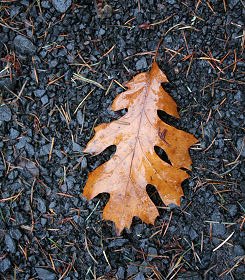
I'll say right off the bat that I hate leaf blowers, just loathe them. They are pretty darn close to the devil incarnate and something I sincerely wish would disappear from the face of the earth. Last year around this time, I had an hour to go running at a park next to my daughter's dance class every Tuesday. And every Tuesday the park maintenance guy would fire up the leaf blower, belching smoke and a vast amount of noise into the air to blow the same 20 leaves off of the sidewalks, until I would abandon the lovely park with its knee-saving bark trail and go run on the residential asphalt just to get away from it. Some days, he would do this in the rain (I watched him blow for at least two minutes on one wet leaf) and somedays in the wind, with the leaves whipping back onto the sidewalks behind him.
I bemoan the lost art of sweeping and raking. Quiet, peaceful, what is more serene than the image of a shopkeeper sweeping his front step and chatting with the passers-by? Instead, the passers-by are assulted by a veritable wall of sound and flying debris. It's hardly neighborly.
All this being said, however, we are now the owners of several gravel paths, for which I am extremely grateful. Last year, when I went down the slope to the chicken coop or garden, it was a slippery mudslide that I descended. This summer, my husband spent an awful lot of time with a wheelbarrow and a shovel dismantling a large gravel pile and turning it into nice, slip-free paths to which every leaf off of our oaks and big leaf maples is now sticking, wet and stubborn, just daring me to try to sweep it up. As I approach the leaves, they wrap their wet leafy selves around the pieces of gravel, bringing half of the path off with them as I rake. Yet if I leave them where they lay, they will once again turn the gravel path into a treacherous slide. The beauty of mother nature returning everything to its natural state.
Of course, the brilliance of the leaf blower is that it's virtually frictionless. Gravel, being heavy, stays put. Leaves, being lighter, fly off. But I Will. Not. Succumb.
So yesterday I spent the afternoon picking the remaining wet leaves off of the paths and throwing them into our raised beds as mulch, cursing the fact that I know a technology exists to do this so much faster and easier. After awhile though, with the peaceful chickens scratching beside me, I just got into a zen-like state of leaf picking and the task became enjoyable: something that got me outside on a blustery day when I probably would've stayed indoors, something that let me work my body - surely the bending and picking were so much better for me than standing in a haze of two-stroke engine fumes and letting compressed carbon do the work for me - something that gave me time to think and contemplate in the middle of a busy set of days.
Today, I have leaf-free non-slippery paths, and a new appreciation for the simpler ways of doing things. Now I'm off to sweep my sidewalks and wave to the neighbors.
Monday, November 20, 2006
Environmental Jenga
I love the conversations I get to have with my kids: long and often rambling, their insights at such young ages never cease to amaze me. I was talking with M. (10) about environmental issues, more specifically about my current non-fiction read The Omnivore's Dilemma (which I highly recommend, but that's a whole 'nother post), when he said "It's kind of like a Jenga game, isn't it? You can take a piece out here or there, a species or an ecosystem, and it seems small enough and the whole thing keeps standing. But eventually there comes a time when the piece you take out will make the whole thing fall. I think we might be close to that time."
Out of the mouths of babes...
I love the conversations I get to have with my kids: long and often rambling, their insights at such young ages never cease to amaze me. I was talking with M. (10) about environmental issues, more specifically about my current non-fiction read The Omnivore's Dilemma (which I highly recommend, but that's a whole 'nother post), when he said "It's kind of like a Jenga game, isn't it? You can take a piece out here or there, a species or an ecosystem, and it seems small enough and the whole thing keeps standing. But eventually there comes a time when the piece you take out will make the whole thing fall. I think we might be close to that time."
Out of the mouths of babes...
Sunday, November 19, 2006

The Path to Friendship
Just outside my back gate is a rough path. It leads across a straw-strewn (covering newly planted clover) former empty lot that is becoming the house and yard of our good friends. Eventually, that path will lead to their back deck. Our children and theirs will run back and forth along it to each others' houses. I can see myself walking along it, trailing steam from an oversized mug of tea, to share a morning moment with my friends, can hear shouted messages at twlight for the kids to come on back from mucking around the creek or throwing a frisbee.
Just outside my back gate is a rough path. It leads across a straw-strewn (covering newly planted clover) former empty lot that is becoming the house and yard of our good friends. Eventually, that path will lead to their back deck. Our children and theirs will run back and forth along it to each others' houses. I can see myself walking along it, trailing steam from an oversized mug of tea, to share a morning moment with my friends, can hear shouted messages at twlight for the kids to come on back from mucking around the creek or throwing a frisbee.
Their house is aiming for to be a "Net Zero" or near Zero energy use house. They're incorporating all kinds of wonderful design aspects, from a huge rainwater catchment basin under the deck to innovative drainfields and solar power. I am really excited to see their design taking shape, and to get to learn from the processes that they are using. We aren't building a new house any time soon, but hope to gradually implement some of these ideas as we add to our existing structure and lot (for instance, a greenhouse addition that we are contemplating might have built-in rainwater catchment underneath its foundation.)
More than anything, I'm grateful that the view from my windows is friendship, community, good neighbors.
Thursday, November 16, 2006
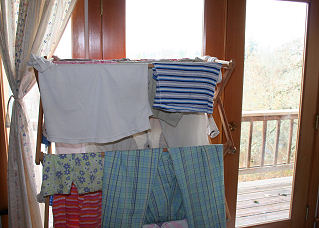
The Clutter of Doing the Right Thing
I went over to my friend's house the other day and her entire living room was filled with laundry, literally! They moved their laundry umbrella in from outside when it started raining, and the living room is the only place big enough to put it. She laughed and said "don't mind the laundry" while her teenage daughter looked for any mortifying underwear in evidence. And the thing is, I don't mind the laundry, I'm there to see my friend.
We're lucky enough to be in a friendship and circle of friends and community and even a town that supports sustainability, even if that means socks in your living room. I also have re-used glass jars and washed ziplock baggies drying on my kitchen counters, bowls of drying seeds and pods from the garden on top of the microwave, and the laundry rack in our bedroom. I know that in other cities or communities, other suburban cultures, this sort of general untidyness of life would be something to be avoided at all costs. I think of my friends from other times and places with their lovely parquet floors and matching throw pillows and exquisitely framed artwork and I do experience a twinge of something - envy maybe? - at the lovely magazine-cover neatness of it all. But also relief that my house can be more utilitarian than decorative (though it still cleans up real nice for a party, when the laundry is very much not in evidence!)
The bottom line is that when you have a three-tiered compost system on your counter (there's the vegetable scraps for the guinea pigs, other food scraps except citrus for the chickens, and the main compost bin for everything else), your kitchen probably won't win any Martha Stewart awards for decor. And when your dryer only gets turned on once a month, you end up with more than a few socks hanging around. But you also end up with10 kg less of Co2 into the atmosphere from the clothes dryer alone, and that can only be a good thing, even factoring in childhood trauma induced by someone seeing underwear in your living room.
I went over to my friend's house the other day and her entire living room was filled with laundry, literally! They moved their laundry umbrella in from outside when it started raining, and the living room is the only place big enough to put it. She laughed and said "don't mind the laundry" while her teenage daughter looked for any mortifying underwear in evidence. And the thing is, I don't mind the laundry, I'm there to see my friend.
We're lucky enough to be in a friendship and circle of friends and community and even a town that supports sustainability, even if that means socks in your living room. I also have re-used glass jars and washed ziplock baggies drying on my kitchen counters, bowls of drying seeds and pods from the garden on top of the microwave, and the laundry rack in our bedroom. I know that in other cities or communities, other suburban cultures, this sort of general untidyness of life would be something to be avoided at all costs. I think of my friends from other times and places with their lovely parquet floors and matching throw pillows and exquisitely framed artwork and I do experience a twinge of something - envy maybe? - at the lovely magazine-cover neatness of it all. But also relief that my house can be more utilitarian than decorative (though it still cleans up real nice for a party, when the laundry is very much not in evidence!)
The bottom line is that when you have a three-tiered compost system on your counter (there's the vegetable scraps for the guinea pigs, other food scraps except citrus for the chickens, and the main compost bin for everything else), your kitchen probably won't win any Martha Stewart awards for decor. And when your dryer only gets turned on once a month, you end up with more than a few socks hanging around. But you also end up with10 kg less of Co2 into the atmosphere from the clothes dryer alone, and that can only be a good thing, even factoring in childhood trauma induced by someone seeing underwear in your living room.
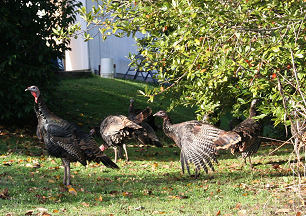
A. spotted a whole flock of turkeys on our neighbor's lawn yesterday morning. They wandered through the neighborhood for an hour or so, making house calls. Aren't they beautiful? They make the cutest little noises. I was hoping one of the males would give us a good show of his tail, but it didn't happen. A few months ago we had some come right by our house and the lead male kept puffing up into this impressive display.
I still can't ride my bicycle, but I suppose that's a blessing with the ever-changeable weather. As you can see in the photo, yesterday morning was gloriously sunny and blue, but within a few hours it was blowing and raining like a true Northwest November. I was glad not to be somewhere around town with only my bike to get home on!
Tuesday, November 14, 2006
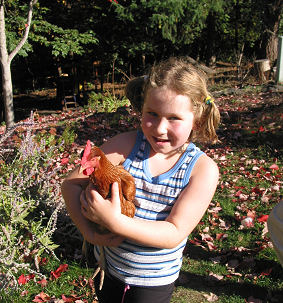
I Didn't Mean to Write About Gravedigging Today
I was going to write an eloquent post about how starting to become an urban farmer has brought me out into nature in all its states. I went out to close up the chicken coop in a raging windstorm the other night. Today has me mulching in the chilly fall sunshine. On days when I otherwise would be bundled up inside, I am now compelled to be out tending to garden and animals. It's nice in a way, I think it brings a greater connection to nature that isn't dependent on sunny skies and mild temperatures. It brings me face to face with the way the world really is, which is not climate controlled.
Instead though, I'm going to write about another side benefit (if I can bring myself to think of it that way) of the urban farming lifestyle: being dragged into close contact with nature's lifecycles. We had a mysterious chicken death yesterday. I went down to check on the ladies, and there was Speeder, face down in the middle of the chicken coop floor, looking for all intents and purposes as if she'd just decided to take a late afternoon snooze.
There was no blood around the deceased, no evidence of flying feathers, no wounds, no other indications of sickness (do chickens vomit? I don't know, but I checked for that too). She weighed a healthy chickenly amount, her combs (or "cluckers" as the kids call them) were all nice and pink and not scaly, her feathers are glossy and golden (this photo was taken last week, and you can clearly see that she is a chicken in the prime of her life.) In short, she looks reasonably healthy, except for the fact that she's dead. At only two years old, she's a bit young for a chicken heart attack (do chickens have heart attacks? Maybe I shouldn't have fed them those buttered toast scraps), but my only other conclusions are possible spider bite, or maybe she happened to peck at something like the mushrooms and toadstools that are cropping up everywhere after all this rain.
Regardless, this afternoon saw me solemnly digging a grave, standing beside it with my children and saying a few words about Speeder's life, as well as chicken heaven (somehow, "dog heaven" sounds much more dignified than "chicken heaven".) Then I played Taps on the recorder (ah, the things you do as a parent) and shoveled on the dirt.
This wasn't a pleasant duty, but in a way it also brought me closer to real life. I've read about rigor mortis, but never actually felt it before (the time my mom put my hamster in the freezer so we could bury her in the new house we're moving to doesn't really count.) I've been able to turn my head from death in that peculiar way that we in the Western World are able to do. Like our climate-controlled houses, our reality-controlled lives let us slip past the harsh and often messy realities of birth, death, sickness, old age, dying. Instead, working with earth, plants, animals, getting our hands messy in the dirt of the world, we come face to face with bad weather, bugs and grubs, stricken plants, and yes, dead chickens. As I say goodbye to Speeder and tamp down the earth, in an odd way it feels like a blessing.
I was going to write an eloquent post about how starting to become an urban farmer has brought me out into nature in all its states. I went out to close up the chicken coop in a raging windstorm the other night. Today has me mulching in the chilly fall sunshine. On days when I otherwise would be bundled up inside, I am now compelled to be out tending to garden and animals. It's nice in a way, I think it brings a greater connection to nature that isn't dependent on sunny skies and mild temperatures. It brings me face to face with the way the world really is, which is not climate controlled.
Instead though, I'm going to write about another side benefit (if I can bring myself to think of it that way) of the urban farming lifestyle: being dragged into close contact with nature's lifecycles. We had a mysterious chicken death yesterday. I went down to check on the ladies, and there was Speeder, face down in the middle of the chicken coop floor, looking for all intents and purposes as if she'd just decided to take a late afternoon snooze.
There was no blood around the deceased, no evidence of flying feathers, no wounds, no other indications of sickness (do chickens vomit? I don't know, but I checked for that too). She weighed a healthy chickenly amount, her combs (or "cluckers" as the kids call them) were all nice and pink and not scaly, her feathers are glossy and golden (this photo was taken last week, and you can clearly see that she is a chicken in the prime of her life.) In short, she looks reasonably healthy, except for the fact that she's dead. At only two years old, she's a bit young for a chicken heart attack (do chickens have heart attacks? Maybe I shouldn't have fed them those buttered toast scraps), but my only other conclusions are possible spider bite, or maybe she happened to peck at something like the mushrooms and toadstools that are cropping up everywhere after all this rain.
Regardless, this afternoon saw me solemnly digging a grave, standing beside it with my children and saying a few words about Speeder's life, as well as chicken heaven (somehow, "dog heaven" sounds much more dignified than "chicken heaven".) Then I played Taps on the recorder (ah, the things you do as a parent) and shoveled on the dirt.
This wasn't a pleasant duty, but in a way it also brought me closer to real life. I've read about rigor mortis, but never actually felt it before (the time my mom put my hamster in the freezer so we could bury her in the new house we're moving to doesn't really count.) I've been able to turn my head from death in that peculiar way that we in the Western World are able to do. Like our climate-controlled houses, our reality-controlled lives let us slip past the harsh and often messy realities of birth, death, sickness, old age, dying. Instead, working with earth, plants, animals, getting our hands messy in the dirt of the world, we come face to face with bad weather, bugs and grubs, stricken plants, and yes, dead chickens. As I say goodbye to Speeder and tamp down the earth, in an odd way it feels like a blessing.
Monday, November 13, 2006
Imagine, a Connected Life
One of the things I love about where we live is that I feel a part of an interconnected web. Part of it is the town, which is small enough to know many people. If we go to the library, the farmer's market, the pool, or the neighborhood store, we're very likely to run into someone we know. Part of it is the neighborhood we chose, one in which community is highly valued. We have an "intentional neighborhood" a block or so down the street, but almost everyone in the blocks around us is very community-oriented. Part of it is the circles we run in, which tend to overlap and intersect so we are always meeting people who know people who we know. Unschooling, sustainability, community, music, gardening, these themes that run through our lives bring us in contact with the most wonderful people.
This week, we took a toy bouncy horse that my kids had outgrown to a homeschooling family down the street that we met at the gym last year. They're now taking violin lessons from my daughter's old teacher. The violin teacher emailed me last week about whether or not a "chicken tractor" that she borrowed from us could be loaned to someone else. In turn, I need to call her to ask if we might be able to use her partner's saws to cut some wood for a bookcase. The circles go on and on with people helping, communicating, introducing people to other people until it feels like there is a giant lovely web that we have all somehow built.
I have lived places without this web, and it can feel lonely, isolated, disconnected. I think we are meant to feel this web connecting us - a feeling that if we somehow were to stumble or fall, that other people would hold their threads strong and we would be okay. Without that, it sometimes feels as if there is an abyss below our feet and that if somehow lose our tenuous grasp of things, we will disappear into its maw. I think about the stress that people feel in "modern life" and believe it is largely the stress of complete self-reliance, something we are probably not meant to ever be.
One of the things I love about where we live is that I feel a part of an interconnected web. Part of it is the town, which is small enough to know many people. If we go to the library, the farmer's market, the pool, or the neighborhood store, we're very likely to run into someone we know. Part of it is the neighborhood we chose, one in which community is highly valued. We have an "intentional neighborhood" a block or so down the street, but almost everyone in the blocks around us is very community-oriented. Part of it is the circles we run in, which tend to overlap and intersect so we are always meeting people who know people who we know. Unschooling, sustainability, community, music, gardening, these themes that run through our lives bring us in contact with the most wonderful people.
This week, we took a toy bouncy horse that my kids had outgrown to a homeschooling family down the street that we met at the gym last year. They're now taking violin lessons from my daughter's old teacher. The violin teacher emailed me last week about whether or not a "chicken tractor" that she borrowed from us could be loaned to someone else. In turn, I need to call her to ask if we might be able to use her partner's saws to cut some wood for a bookcase. The circles go on and on with people helping, communicating, introducing people to other people until it feels like there is a giant lovely web that we have all somehow built.
I have lived places without this web, and it can feel lonely, isolated, disconnected. I think we are meant to feel this web connecting us - a feeling that if we somehow were to stumble or fall, that other people would hold their threads strong and we would be okay. Without that, it sometimes feels as if there is an abyss below our feet and that if somehow lose our tenuous grasp of things, we will disappear into its maw. I think about the stress that people feel in "modern life" and believe it is largely the stress of complete self-reliance, something we are probably not meant to ever be.
Sunday, November 12, 2006
Stuck in a Car
Just whining here... I injured my foot last weekend in my triathlon and now I can't walk, I can't bike, I am basically just limping around. I realize that I've taken this all for granted in the past, this ability to completely get around under my own steam! We tried to take a family walk to the store yesterday and I made it about a quarter mile. My husband had to take the kids while I limped home.
Plus, it's pouring rain today and just blah. [end whine]
Just whining here... I injured my foot last weekend in my triathlon and now I can't walk, I can't bike, I am basically just limping around. I realize that I've taken this all for granted in the past, this ability to completely get around under my own steam! We tried to take a family walk to the store yesterday and I made it about a quarter mile. My husband had to take the kids while I limped home.
Plus, it's pouring rain today and just blah. [end whine]
Saturday, November 11, 2006
Back To Autumn
Ten days in Florida on gorgeous sandy beaches, lounging by palm-fringed hotel pools - okay, that was totally awesome. I can't complain at all! But by the time we were ready to come home, I was hungry for the seasonal change of my Northwest home.
Fall here is really stunning. Our town lives in a climactic confluence that gives it an astonishing variety of deciduous trees. The entire town turns gold, russet, purple, orange, canary yellow, dark red, umber, and crimson. The pumpkin patches and corn fields fall gently to pieces, and the rains come and go with brilliant flashes of blue sky between.
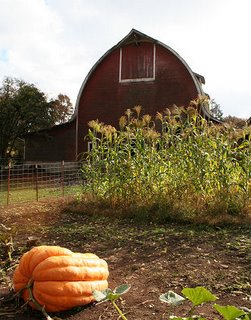
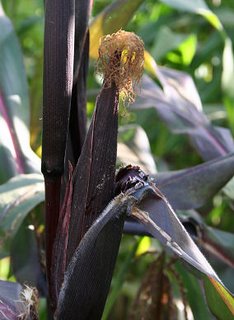
I'm sure by February, I will be dreaming of sunny beaches, but for now Give me Fall!
Ten days in Florida on gorgeous sandy beaches, lounging by palm-fringed hotel pools - okay, that was totally awesome. I can't complain at all! But by the time we were ready to come home, I was hungry for the seasonal change of my Northwest home.
Fall here is really stunning. Our town lives in a climactic confluence that gives it an astonishing variety of deciduous trees. The entire town turns gold, russet, purple, orange, canary yellow, dark red, umber, and crimson. The pumpkin patches and corn fields fall gently to pieces, and the rains come and go with brilliant flashes of blue sky between.
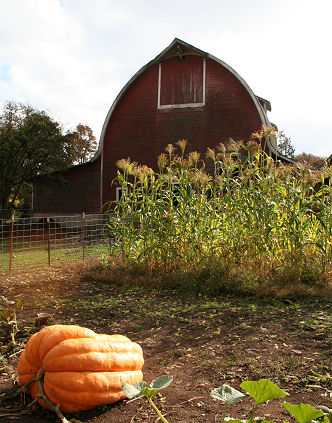
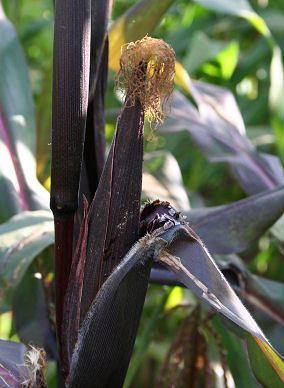
I'm sure by February, I will be dreaming of sunny beaches, but for now Give me Fall!
Monday, October 16, 2006
Continuity
My son is really into Dungeons & Dragons these days, and I was recently inspired to look back through some of my old notebooks from grade school and junior high in an attempt to find my old D&D notes, sketches, and dungeon diagrams to share with him. What I found instead was an old writing assignment from 5th grade, when I was about my son's age. It was entitled "Who I Am" and apparently I was to list all of the things I felt with myself in an "I am a...." format.
The list was long, and includes things that no longer apply (though I am still a guinea pig owner and lover and I do still like to cook pumpkin pie). The thing that struck me most, though, was the continuity of purpose and personality in looking 30 years back at this younger me. I identified myself as a cyclist, a gardener, a swimmer, an environmentalist, and a feminist. On my list was outdoorsperson, hiker, lover of animals, and many entries linking me to family, friends, and community. I listed myself as a Democrat and an American. I also found other telling evidence, copies of letters to then-president Jimmy Carter, urging him to adopt Oregon's bottle bill nationally. A poster I drew for a local contest, sponsored by the utility company, my entry was a drawing of a solar house.
Though I have come through much in the intervening years, it's comforting to see how many of my core values are still such a large part of my life today. The things that mattered to me then, matter now. Community, environment, conservation, family, outdoor activities, political activism. Continuity.
My son is really into Dungeons & Dragons these days, and I was recently inspired to look back through some of my old notebooks from grade school and junior high in an attempt to find my old D&D notes, sketches, and dungeon diagrams to share with him. What I found instead was an old writing assignment from 5th grade, when I was about my son's age. It was entitled "Who I Am" and apparently I was to list all of the things I felt with myself in an "I am a...." format.
The list was long, and includes things that no longer apply (though I am still a guinea pig owner and lover and I do still like to cook pumpkin pie). The thing that struck me most, though, was the continuity of purpose and personality in looking 30 years back at this younger me. I identified myself as a cyclist, a gardener, a swimmer, an environmentalist, and a feminist. On my list was outdoorsperson, hiker, lover of animals, and many entries linking me to family, friends, and community. I listed myself as a Democrat and an American. I also found other telling evidence, copies of letters to then-president Jimmy Carter, urging him to adopt Oregon's bottle bill nationally. A poster I drew for a local contest, sponsored by the utility company, my entry was a drawing of a solar house.
Though I have come through much in the intervening years, it's comforting to see how many of my core values are still such a large part of my life today. The things that mattered to me then, matter now. Community, environment, conservation, family, outdoor activities, political activism. Continuity.
Monday, October 02, 2006
Bicycling Summit
Sometimes I just really love my city, and this is one of those days. They're holding a bicycling and pedestrian summit to focus on making our city even more bicycle and pedestrian friendly. They're also hoping to draw more bicycling tourists here, which I think would be a great idea. I have long thought that we've got some of the best hidden scenery in the world. Just on the other side of the hill I live on are miles and miles of rolling hills, forests, wineries, fields. It's just gorgeous out there. All it needs is some little Tuscany-esque cafes and guest houses scattered about and it would be just about perfect. Somehow, sipping a Gatorade in front of a country store while the trucks roll by just doesn't cut it.
In this summer's construction season, our city also redid a large section of one of our bike paths with all-new concrete instead of the cracking bicycle-eating asphalt. And they've put in dozens of new pedestrian crossings with median strips in the middle of the street. I'm excited that our city continues to commit resources to improve bikeability and walkability.
Unfortunately, I won't be able to attend the bicycling summit, because I have to, well, bicycle, LOL. I only have two long bike rides left before the Ironman, and Saturday will have to be one of them. So I'm hoping to give some input to one of my friends who will be going, and hear back from them on how it all shakes out.
Sometimes I just really love my city, and this is one of those days. They're holding a bicycling and pedestrian summit to focus on making our city even more bicycle and pedestrian friendly. They're also hoping to draw more bicycling tourists here, which I think would be a great idea. I have long thought that we've got some of the best hidden scenery in the world. Just on the other side of the hill I live on are miles and miles of rolling hills, forests, wineries, fields. It's just gorgeous out there. All it needs is some little Tuscany-esque cafes and guest houses scattered about and it would be just about perfect. Somehow, sipping a Gatorade in front of a country store while the trucks roll by just doesn't cut it.
In this summer's construction season, our city also redid a large section of one of our bike paths with all-new concrete instead of the cracking bicycle-eating asphalt. And they've put in dozens of new pedestrian crossings with median strips in the middle of the street. I'm excited that our city continues to commit resources to improve bikeability and walkability.
Unfortunately, I won't be able to attend the bicycling summit, because I have to, well, bicycle, LOL. I only have two long bike rides left before the Ironman, and Saturday will have to be one of them. So I'm hoping to give some input to one of my friends who will be going, and hear back from them on how it all shakes out.
Monday, September 25, 2006
Dance of the Bees
 We must have a good couple of wild honeybee hives somewhere in the woods near our house, because the perennials out front are simply chock full of bees. There's hardly any real estate in the flower beds that doesn't have a bee on it. My daughter says with wonder "Mom, somewhere close to here, a bee must be doing a special dance just to show the others bees where our flower beds are. Isn't that amazing?"
Yes, it is.
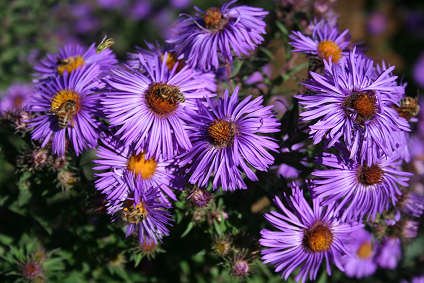 We must have a good couple of wild honeybee hives somewhere in the woods near our house, because the perennials out front are simply chock full of bees. There's hardly any real estate in the flower beds that doesn't have a bee on it. My daughter says with wonder "Mom, somewhere close to here, a bee must be doing a special dance just to show the others bees where our flower beds are. Isn't that amazing?"
 Yes, it is.
Wednesday, September 20, 2006
More Gleaning
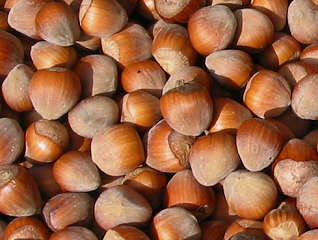 We took a family bike ride on Sunday, a beautiful sunny day, bracketed by rain and drizzle. One of the local running trails goes through an old filbert orchard, and the ground is just covered with fallen hazelnuts. We picked up pounds and pounds of them. Now I just need to get a good nutcracker and we can spend winter nights by the fire cracking open some gorgeous Oregon hazelnuts.
 We took a family bike ride on Sunday, a beautiful sunny day, bracketed by rain and drizzle. One of the local running trails goes through an old filbert orchard, and the ground is just covered with fallen hazelnuts. We picked up pounds and pounds of them. Now I just need to get a good nutcracker and we can spend winter nights by the fire cracking open some gorgeous Oregon hazelnuts.
Friday, September 15, 2006
Gleaning
My little corner of the world is fertile, abundant with fruits. They are just dripping off of trees and vines this time of year. Many are lying wasted on the ground, as busy people with fruit trees in their yards simply don't have the time to harvest and process this Autumn windfall. The squirrels, raccoons, and deer are getting plump and sleek as they boldly stroll around our neighborhood enjoying the smorgasbord. We had a good-sized buck in the back field yesterday, but I didn't get to my camera in time, and he wandered off into the woods.
I've made it a habit of politely inquiring of the people I see out and about if they mind if I pick their fruit from trees that are overflowing with it. Some trees around town even have signs giving permission from the owners ahead of time. The kids and I have also been hitting the neighborhood blackberry vines hard, right up until the first raindrop of Fall fell yesterday evening. So I've got 20+ quarts of blackberries in the freezer, and a kitchen full of apples and pears to process. Our housemate/renter has turned our plum tree into batches of double-boiled jam (a pectin-less recipe from Europe, he says).
It's amazing how much free food there is, just here for the taking around town. Which is a good thing, because last night that buck found the hole in our fence and helped himself to our garden!
My little corner of the world is fertile, abundant with fruits. They are just dripping off of trees and vines this time of year. Many are lying wasted on the ground, as busy people with fruit trees in their yards simply don't have the time to harvest and process this Autumn windfall. The squirrels, raccoons, and deer are getting plump and sleek as they boldly stroll around our neighborhood enjoying the smorgasbord. We had a good-sized buck in the back field yesterday, but I didn't get to my camera in time, and he wandered off into the woods.
I've made it a habit of politely inquiring of the people I see out and about if they mind if I pick their fruit from trees that are overflowing with it. Some trees around town even have signs giving permission from the owners ahead of time. The kids and I have also been hitting the neighborhood blackberry vines hard, right up until the first raindrop of Fall fell yesterday evening. So I've got 20+ quarts of blackberries in the freezer, and a kitchen full of apples and pears to process. Our housemate/renter has turned our plum tree into batches of double-boiled jam (a pectin-less recipe from Europe, he says).
It's amazing how much free food there is, just here for the taking around town. Which is a good thing, because last night that buck found the hole in our fence and helped himself to our garden!
Monday, September 11, 2006

Tuesday, September 05, 2006
Reaping What You Sow
 Yes, it's that time of year. No, not time for massive Back To School ads, stocking up on notebooks, binders, and crayons, and catching the big yellow bus. It's harvest time. I think one has to be wary of new rituals. In looking back historically, any time a new ritual is put forth strongly by the powers that be, it's because it is meant to replace an old ritual, usually one that has value and worth to the people who practice it. Christmas and Easter quite susipciously fall on dates previously occupied by important pagan holidays, dates that basically have nothing whatsoever to do with Christ's birth or death. And the ritual of Back To School falls neatly on top of what used to be the harvest.
Does anyone remember when school actually started in the Fall? There was a reason for that. Kids helped out in the farm, or even just in the garden patch at home. Even when I was growing up (not so long ago, for your information!), many kids were working in the fields or off on hunting trips as the leaves began to fall. Not so anymore. Some kids in the U.S. have already been back at their desks since mid-August, is it any wonder that farm families are finding it hard to keep their children in the family farming tradition? The kids are pulled away from it starting in Kindergarten. As a nation and a culture, we have lost contact with the turning of the seasons, the yearly cycles of abundance and lack. Why bother? We have a grocery store just down the road.
Unschooling gives us the opportunity to revel in the abundance of the season. To pick blackberries all morning and eat corn on the cob right off our stalks for dinner, and yes, to pose as The Statue of Cucumber Liberty. We've got applesauce to brew up, plums to dry, and berries to freeze. Also of course, big empty beaches to visit, lakes to kayak, and campgrounds to occupy, now that they're blissfully quiet. And I hear that the huckleberries are just starting to come on at the coast...
 Yes, it's that time of year. No, not time for massive Back To School ads, stocking up on notebooks, binders, and crayons, and catching the big yellow bus. It's harvest time. I think one has to be wary of new rituals. In looking back historically, any time a new ritual is put forth strongly by the powers that be, it's because it is meant to replace an old ritual, usually one that has value and worth to the people who practice it. Christmas and Easter quite susipciously fall on dates previously occupied by important pagan holidays, dates that basically have nothing whatsoever to do with Christ's birth or death. And the ritual of Back To School falls neatly on top of what used to be the harvest.
 Does anyone remember when school actually started in the Fall? There was a reason for that. Kids helped out in the farm, or even just in the garden patch at home. Even when I was growing up (not so long ago, for your information!), many kids were working in the fields or off on hunting trips as the leaves began to fall. Not so anymore.
 Some kids in the U.S. have already been back at their desks since mid-August, is it any wonder that farm families are finding it hard to keep their children in the family farming tradition? The kids are pulled away from it starting in Kindergarten. As a nation and a culture, we have lost contact with the turning of the seasons, the yearly cycles of abundance and lack. Why bother? We have a grocery store just down the road.
Unschooling gives us the opportunity to revel in the abundance of the season. To pick blackberries all morning and eat corn on the cob right off our stalks for dinner, and yes, to pose as The Statue of Cucumber Liberty. We've got applesauce to brew up, plums to dry, and berries to freeze. Also of course, big empty beaches to visit, lakes to kayak, and campgrounds to occupy, now that they're blissfully quiet. And I hear that the huckleberries are just starting to come on at the coast...
Friday, August 25, 2006
What Did We Do On a Friday?
 We picked up our Bike Friday Tandems and went for a cruise. To the local chocolate factory, of course! We actually picked them up on Wednesday, and have been biking all over the place since then. The kids love them, and I'm so much happier with them safely tucked behind us, it extends our range to streets that I wouldn't go on if they were on their own bikes, and extends our distance and shortens our time to get there as well!
Now, the only major question is: is it more fun to bike with my kids on a tandem, or with my husband?? We dropped the kids off at their robotics camp this morning, then put the seat up on one of the tandems and took off together on our "bicycle built for two". They say that riding a tandem will either make or break a marriage, but we have already flown an airplane together (and he is a notorious backseat driver, er, pilot) so I figured we would be okay. It was fun, crazy, and a little scary. From the back, I can't see much, and have to rely on what it feels like he's about to do (turn, stop, coast). From the front, I have to keep the balance, which is a lot harder with him on the back than with one of the kids! You have to stop and start, lean, coast, and pedal together, and we were both laughing our heads off just trying to get the thing started. What fun.
 We picked up our Bike Friday Tandems and went for a cruise. To the local chocolate factory, of course! We actually picked them up on Wednesday, and have been biking all over the place since then. The kids love them, and I'm so much happier with them safely tucked behind us, it extends our range to streets that I wouldn't go on if they were on their own bikes, and extends our distance and shortens our time to get there as well!
Now, the only major question is: is it more fun to bike with my kids on a tandem, or with my husband?? We dropped the kids off at their robotics camp this morning, then put the seat up on one of the tandems and took off together on our "bicycle built for two". They say that riding a tandem will either make or break a marriage, but we have already flown an airplane together (and he is a notorious backseat driver, er, pilot) so I figured we would be okay. It was fun, crazy, and a little scary. From the back, I can't see much, and have to rely on what it feels like he's about to do (turn, stop, coast). From the front, I have to keep the balance, which is a lot harder with him on the back than with one of the kids! You have to stop and start, lean, coast, and pedal together, and we were both laughing our heads off just trying to get the thing started. What fun.
Sunday, August 20, 2006
On My Bookshelf
Seed to Seed: Seed Saving and Growing Techniques for Vegetable Gardeners by Suzanne Ashworth
Someone recommended this excellent book to me and it is totally chock full of information you need to get started with seed saving. I have to admit it is pretty overwhelming, when you start thinking about isolating various crops from cross-pollination (especially since many of our neighbors have vegetable gardens) and all the different techniques you need for different vegetables. I got the book out from the library, but I can already tell I'll need to buy it to use as a more or less constant reference. I'm saving seeds this year from a few easy plants - melons, pumpkins, edameme, and I'll try the harder stuff as we go.
Seed to Seed: Seed Saving and Growing Techniques for Vegetable Gardeners by Suzanne Ashworth
Someone recommended this excellent book to me and it is totally chock full of information you need to get started with seed saving. I have to admit it is pretty overwhelming, when you start thinking about isolating various crops from cross-pollination (especially since many of our neighbors have vegetable gardens) and all the different techniques you need for different vegetables. I got the book out from the library, but I can already tell I'll need to buy it to use as a more or less constant reference. I'm saving seeds this year from a few easy plants - melons, pumpkins, edameme, and I'll try the harder stuff as we go.
Wednesday, August 09, 2006
When Bad Things Happen to Good Chickens
This weekend a dog in the neighborhood killed three of our beloved chickens. On our property, right in front of the kids, with me trying to get the dog away and frantically calling for the owners to come get the dog. I can still hear my daughter's voice in my head "Mommy, he's killing Goldie! Mommmmmmyyyyyy!!!!" and like those awful slow-motion dreams, not being able to get there in time to stop this dog. We buried them with a small ceremony on Saturday night, but the sadness won't leave for awhile.
When we got chickens, it was for the purpose of laying eggs - a sort of a utilitarian feature. I was unprepared for how endearing these creatures could be, how they would each have their own personality and quirks, how they would follow me around while gardening, with their soft little "bwaaaks" and squawks, looking for the bugs and worms I turned up. And so I was unprepared for the amount of grief that their demise has brought.
Goldie was our first egg-layer. For reasons unknown, she picked the side-vent of our house as a likely nesting box and laid her first few eggs in there. Afterwards, she would walk around the yard, loudly and proudly proclaiming her accomplishment. It was so fun for the kids to find those first few eggs.
Boudicca the Fierce was the leader of the whole chicken tribe, top of the pecking order (and the most likely to peck at me when she was a little chick). She was fiesty and funny.
And our beloved Dingbat, who was originally named Aphrodite, but renamed when her vision problems caused her to miss the door to the pen and run into the wire on many occasions. She also had a gimpy toe, that probably went along with her poor vision, but she had a very sweet temperament, and was the only chicken to take our new babies under her wing this year and shepherd them around the yard.

These three sweet being brought smiles and their funny silly chicken antics into our lives and we will miss them terribly. I know that out there in the big world people are having much worse days than this. I know people in many places would give their eyeteeth to have a day where only chickens die (or even be happy, because then they would have a decent meal), but for us, we've lost some beloved pets and we are grieving "just for chickens".
RIP Goldie, Boudicca the Fierce, and Dingbat.
This weekend a dog in the neighborhood killed three of our beloved chickens. On our property, right in front of the kids, with me trying to get the dog away and frantically calling for the owners to come get the dog. I can still hear my daughter's voice in my head "Mommy, he's killing Goldie! Mommmmmmyyyyyy!!!!" and like those awful slow-motion dreams, not being able to get there in time to stop this dog. We buried them with a small ceremony on Saturday night, but the sadness won't leave for awhile.
When we got chickens, it was for the purpose of laying eggs - a sort of a utilitarian feature. I was unprepared for how endearing these creatures could be, how they would each have their own personality and quirks, how they would follow me around while gardening, with their soft little "bwaaaks" and squawks, looking for the bugs and worms I turned up. And so I was unprepared for the amount of grief that their demise has brought.
Goldie was our first egg-layer. For reasons unknown, she picked the side-vent of our house as a likely nesting box and laid her first few eggs in there. Afterwards, she would walk around the yard, loudly and proudly proclaiming her accomplishment. It was so fun for the kids to find those first few eggs.
Boudicca the Fierce was the leader of the whole chicken tribe, top of the pecking order (and the most likely to peck at me when she was a little chick). She was fiesty and funny.
And our beloved Dingbat, who was originally named Aphrodite, but renamed when her vision problems caused her to miss the door to the pen and run into the wire on many occasions. She also had a gimpy toe, that probably went along with her poor vision, but she had a very sweet temperament, and was the only chicken to take our new babies under her wing this year and shepherd them around the yard.

These three sweet being brought smiles and their funny silly chicken antics into our lives and we will miss them terribly. I know that out there in the big world people are having much worse days than this. I know people in many places would give their eyeteeth to have a day where only chickens die (or even be happy, because then they would have a decent meal), but for us, we've lost some beloved pets and we are grieving "just for chickens".
RIP Goldie, Boudicca the Fierce, and Dingbat.
Wednesday, August 02, 2006
Nothing Like Scarcity
We camped in the desert for 6 days this week. There's nothing like having no water around for miles and miles to really make you appreciate the stuff. To savor every drop. To be completely and totally aware of how you use it. I think here in the reasonably rainy PacNW, we forget what a precious commodity water really is. Especially the clean, drinkable stuff. When you're out there in the dust zone, straining off your cooking water into another pot so you can re-use it to wash dishes, and emptying the water from your cooler into your dog's bowl, it becomes much more apparent.
It was a great journey, in many ways. And coming back, I have a new appreciation for the ease at which I can turn on a faucet and get beautiful clear water to fill my glass.
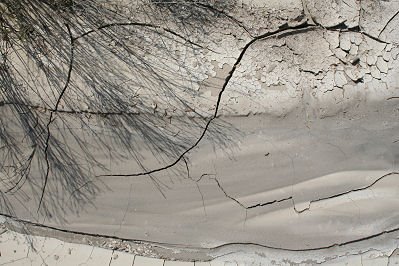
We camped in the desert for 6 days this week. There's nothing like having no water around for miles and miles to really make you appreciate the stuff. To savor every drop. To be completely and totally aware of how you use it. I think here in the reasonably rainy PacNW, we forget what a precious commodity water really is. Especially the clean, drinkable stuff. When you're out there in the dust zone, straining off your cooking water into another pot so you can re-use it to wash dishes, and emptying the water from your cooler into your dog's bowl, it becomes much more apparent.
It was a great journey, in many ways. And coming back, I have a new appreciation for the ease at which I can turn on a faucet and get beautiful clear water to fill my glass.
Tuesday, July 11, 2006
The New Family Vehicle
After a couple of years of deliberation, we finally ordered our new family tandem bicycles today. So far, the Burley Piccolo (tag-a-long) has been suiting us fairly well. I started off cycling with both kids in the Burley trailer, then moved M. to the tag-a-long while A. was still small enough to be in the trailer. When she turned 5, she moved up to the tag-a-long, which meant that M. had to ride his own bike. That works well for the many streets in town that are bike-friendly and relatively traffic free, but it limits us when we want to go somewhere that has more cars or I feel is too dangerous for him to navigate. On a street with lots of traffic and a narrow bike lane, one swerve on his part could be disastrous. The tandem will free us up to go longer distances, faster, and also to go on streets where I feel more comfortable being in control of the whole bike and both kids. So we'll hook the tag-a-long to the back of the tandem and off we'll go! For days when DH is around, we can take both tandems.
Here's the Bike Friday folding tandem I'll be using with the kids!
After a couple of years of deliberation, we finally ordered our new family tandem bicycles today. So far, the Burley Piccolo (tag-a-long) has been suiting us fairly well. I started off cycling with both kids in the Burley trailer, then moved M. to the tag-a-long while A. was still small enough to be in the trailer. When she turned 5, she moved up to the tag-a-long, which meant that M. had to ride his own bike. That works well for the many streets in town that are bike-friendly and relatively traffic free, but it limits us when we want to go somewhere that has more cars or I feel is too dangerous for him to navigate. On a street with lots of traffic and a narrow bike lane, one swerve on his part could be disastrous. The tandem will free us up to go longer distances, faster, and also to go on streets where I feel more comfortable being in control of the whole bike and both kids. So we'll hook the tag-a-long to the back of the tandem and off we'll go! For days when DH is around, we can take both tandems.
Here's the Bike Friday folding tandem I'll be using with the kids!
Sunday, July 09, 2006
New Garden Pics

All the raised beds are in, and things are growing really well. We've gotten a good number of snap peas, and planted more lettuce than we could eat. I haven't bought anything green from the store in weeks! The squirrels have taken all the strawberries (they'll be moved up to planters on the deck). Here's a couple pics of our new garden space. This one is taken from the top deck, looking down into the back.
This is the "shade garden", mostly perennial shade lovers, and I've added in some blueberries and huckleberries into this area:
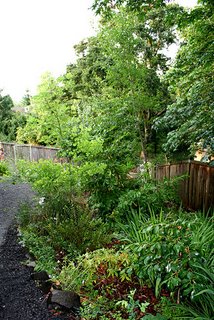
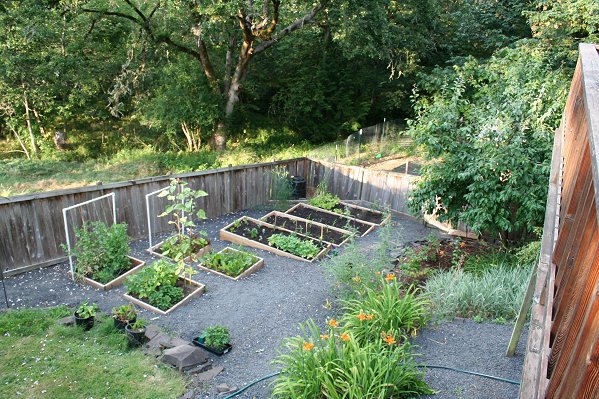
All the raised beds are in, and things are growing really well. We've gotten a good number of snap peas, and planted more lettuce than we could eat. I haven't bought anything green from the store in weeks! The squirrels have taken all the strawberries (they'll be moved up to planters on the deck). Here's a couple pics of our new garden space. This one is taken from the top deck, looking down into the back.
This is the "shade garden", mostly perennial shade lovers, and I've added in some blueberries and huckleberries into this area:

Monday, July 03, 2006
A Little Bit of Anything Adds Up
I watered my garden yesterday with 10 gallons of water that would've gone down the drain. I've always dreamed of having some sort of graywater recovery system, but retrofitting one into this house would be a major and expensive project. So I decided to do something small to recover just some of the graywater - put a five gallon bucket in our shower, and whenever we turn on the shower to warm it up (which takes awhile on the second floor because the water heater is in the basement), the cold water that's running can go into the bucket. It's a shame to waste all of that clean water just because it's not warm!
After a couple of weeks of trying it, I'll say that the bucket system is working really well. Best of all, when you start looking at saving one little wasteful bit, it really opens your eyes to all the other bits that you're also throwing away. Now when I drain my cooler after camping, I drain it into a bucket. If I don't want to use it right then, I can just pour it into our rain barrel. And when I shower, I'm more cognizant of the amount of water that's being wasted, so I only turn the water on halfway - it still feels like a full shower, but it's using half as much water!
Sometimes it feels overwhelming to think about all of the things we'd like to change to become more sustainable. Making just one small change is easy though, and so many other changes can flow naturally from that. I recently read some wise words: "Walk in the direction you want to be going." It sounds so simple and it's really true. You don't have to get there today, but if you put one foot on the path, you're headed there eventually.
I watered my garden yesterday with 10 gallons of water that would've gone down the drain. I've always dreamed of having some sort of graywater recovery system, but retrofitting one into this house would be a major and expensive project. So I decided to do something small to recover just some of the graywater - put a five gallon bucket in our shower, and whenever we turn on the shower to warm it up (which takes awhile on the second floor because the water heater is in the basement), the cold water that's running can go into the bucket. It's a shame to waste all of that clean water just because it's not warm!
After a couple of weeks of trying it, I'll say that the bucket system is working really well. Best of all, when you start looking at saving one little wasteful bit, it really opens your eyes to all the other bits that you're also throwing away. Now when I drain my cooler after camping, I drain it into a bucket. If I don't want to use it right then, I can just pour it into our rain barrel. And when I shower, I'm more cognizant of the amount of water that's being wasted, so I only turn the water on halfway - it still feels like a full shower, but it's using half as much water!
Sometimes it feels overwhelming to think about all of the things we'd like to change to become more sustainable. Making just one small change is easy though, and so many other changes can flow naturally from that. I recently read some wise words: "Walk in the direction you want to be going." It sounds so simple and it's really true. You don't have to get there today, but if you put one foot on the path, you're headed there eventually.
Wednesday, June 07, 2006
Bambi Vs. Godzilla
I don't know if you've seen this short film, Bambi Vs. Godzilla, made in 1969. You can view it here. It's very simple: Bambi is in the forest, looking around at the beautiful meadows and butterflies and such, and then Godzilla's foot comes down and stomps him flat. I just went to a memorial service (celebration of life) for a friend who was out bicycling in the beautiful meadows and was hit by a logging truck. Kind of like Godzilla's foot, out of nowhere. She was a really, truly amazing person. It's times like this when I wish I hadn't seen so many episodes of Six Feet Under, because it somehow allows a window into seeing the grim reality of death and what it all really means to the corporeal body. I've been torn this week with so many conflicting emotions - sadness of course, and a feeling of tragedy, a life cut way too short - especially such a dynamic life, the memories of the person, the spirit, the life of such a person, the ugly reality of such a death, the fear that you don't always express but is still there when you spend thousands of miles a year on a bicycle, among large multi-ton objects moving twice as fast as you, the feeling that you shouldn't have to feel such a fear, that you just want to enjoy the beautiful feeling of freedom that riding a bicycle can be.
I was on that same road, not all that many hours before she was. Those logging trucks have passed me so many times. Maybe that logging truck. But it's not just that road, and it's not just that truck. Today, bicycling to her service, I had to change lanes in traffic and the guy behind me roared up on my rear wheel and honked. Never mind I legally can use a lane of traffic just like any other vehicle. Normally drivers here are quite used to bicycles and often very courteous. Maybe this guy just moved here from California, along with half our new population, I don't know. Before that, I biked with my kids to gymnastics, and had to negotiate a several-block stretch of busy road with no bike lanes. I hate that bit of road. I hate not knowing if some driver will come roaring too close to my kids. But what is the alternative? Live in fear? Only drive a car? As if people don't get killed in cars every day of the year? Have my kids grow up feeling entitled to drive big hulks of moving, resource-sucking metal because otherwise the other hulk-drivers might accidentally just kill them? God, I hate this feeling. I hate not having a good choice, only the ability to choose between bad ones. Drive the resource-sucking hulk, bike with my kids on dangerous road, tell my kids they can't go to gymnastics because the gym is on such a bad road. Where's the good choice?
I'm rambling, I know. I'm still in some shock that this person is gone. The service was amazing. Totally packed with people, showing the amazing depth and breadth of her influence on the many people in her life. People telling stories about her, about the incredible person that she was, all the dimensions of her life. I'm in shock at her death. I'm sad and scared and also full of the knowledge that this won't stop me from going out on the road either. I biked that road again yesterday, the one with the logging trucks - it's such a short stretch of road, but it connects so many of the local bike routes. To avoid it would be to cut out half the great local routes. My husband is out somewhere on his bike right now, coming home from work, 10 miles away. So if you're reading this and you're a hulk driver (as are many of us, even those of us who cycle as well) please take this moment to reflect that nothing is worth driving in a way that endangers the pedestrians and cyclists that share the roads with you. There's no appointment so important, no moment so big that you might miss that is worth someone's life. Please, drive safely out there.
I don't know if you've seen this short film, Bambi Vs. Godzilla, made in 1969. You can view it here. It's very simple: Bambi is in the forest, looking around at the beautiful meadows and butterflies and such, and then Godzilla's foot comes down and stomps him flat. I just went to a memorial service (celebration of life) for a friend who was out bicycling in the beautiful meadows and was hit by a logging truck. Kind of like Godzilla's foot, out of nowhere. She was a really, truly amazing person. It's times like this when I wish I hadn't seen so many episodes of Six Feet Under, because it somehow allows a window into seeing the grim reality of death and what it all really means to the corporeal body. I've been torn this week with so many conflicting emotions - sadness of course, and a feeling of tragedy, a life cut way too short - especially such a dynamic life, the memories of the person, the spirit, the life of such a person, the ugly reality of such a death, the fear that you don't always express but is still there when you spend thousands of miles a year on a bicycle, among large multi-ton objects moving twice as fast as you, the feeling that you shouldn't have to feel such a fear, that you just want to enjoy the beautiful feeling of freedom that riding a bicycle can be.
I was on that same road, not all that many hours before she was. Those logging trucks have passed me so many times. Maybe that logging truck. But it's not just that road, and it's not just that truck. Today, bicycling to her service, I had to change lanes in traffic and the guy behind me roared up on my rear wheel and honked. Never mind I legally can use a lane of traffic just like any other vehicle. Normally drivers here are quite used to bicycles and often very courteous. Maybe this guy just moved here from California, along with half our new population, I don't know. Before that, I biked with my kids to gymnastics, and had to negotiate a several-block stretch of busy road with no bike lanes. I hate that bit of road. I hate not knowing if some driver will come roaring too close to my kids. But what is the alternative? Live in fear? Only drive a car? As if people don't get killed in cars every day of the year? Have my kids grow up feeling entitled to drive big hulks of moving, resource-sucking metal because otherwise the other hulk-drivers might accidentally just kill them? God, I hate this feeling. I hate not having a good choice, only the ability to choose between bad ones. Drive the resource-sucking hulk, bike with my kids on dangerous road, tell my kids they can't go to gymnastics because the gym is on such a bad road. Where's the good choice?
I'm rambling, I know. I'm still in some shock that this person is gone. The service was amazing. Totally packed with people, showing the amazing depth and breadth of her influence on the many people in her life. People telling stories about her, about the incredible person that she was, all the dimensions of her life. I'm in shock at her death. I'm sad and scared and also full of the knowledge that this won't stop me from going out on the road either. I biked that road again yesterday, the one with the logging trucks - it's such a short stretch of road, but it connects so many of the local bike routes. To avoid it would be to cut out half the great local routes. My husband is out somewhere on his bike right now, coming home from work, 10 miles away. So if you're reading this and you're a hulk driver (as are many of us, even those of us who cycle as well) please take this moment to reflect that nothing is worth driving in a way that endangers the pedestrians and cyclists that share the roads with you. There's no appointment so important, no moment so big that you might miss that is worth someone's life. Please, drive safely out there.
Friday, May 19, 2006
When I Burn Gas, I'm Supporting the War (and Every Other American Policy I Disagree With)
It seems so simple, but it's so hard to wrap one's head around. Everything presented to us in the media is so separated - this event happens here, this policy happens there, the president does this, congress votes for that. It's difficult to see the direct result of any actions that we personally take.
But the realization has been dawning on me that every single action I take is tied to every action taken "out there" in the political world. The war wouldn't be happening if almost every American wasn't burning way too much gas (and not just in our cars, but with our lifestyles, the things we buy, what we eat, etc.) Going to peace rallies and writing our congressman is all well and good, but if we are going to effect any positive change whatsoever, it is imperative that we stop doing this now. More wars will have to be fought for oil if we continue to use it to fuel our existance. If I wouldn't be willing to sacrifice my kids to those future wars, then I can't, in good conscience, live a lifestyle that will require them to be fought.
So, for personal accountability, I've started keeping a mileage log. My immediate goal is to bring my gas-powered miles below my human powered miles, specifically my transportation miles (not my biking and running for exercise and fun miles). If you are interested in effecting real change in our world, in the policies of our nations and leaders, and in our future, I urge you to give this a try as well. Of course, there are more pieces to the pie than just this. Not buying unnecessary stuff, buying local food, etc. etc. But this is a good first step at personal accountability for what is going on "out there"
Mileage For the Week
Car, Gas: 43 miles, 2.2 gallons
Car, Gas, Carpooling: 21 miles, 1 gallon/2 families = .5 gallons
Car, Biodiesel: 41 miles, 1 gallon
Bike, with kids: 21
Bike, town, no kids: 11
Walking, with kids: 1.5
It seems so simple, but it's so hard to wrap one's head around. Everything presented to us in the media is so separated - this event happens here, this policy happens there, the president does this, congress votes for that. It's difficult to see the direct result of any actions that we personally take.
But the realization has been dawning on me that every single action I take is tied to every action taken "out there" in the political world. The war wouldn't be happening if almost every American wasn't burning way too much gas (and not just in our cars, but with our lifestyles, the things we buy, what we eat, etc.) Going to peace rallies and writing our congressman is all well and good, but if we are going to effect any positive change whatsoever, it is imperative that we stop doing this now. More wars will have to be fought for oil if we continue to use it to fuel our existance. If I wouldn't be willing to sacrifice my kids to those future wars, then I can't, in good conscience, live a lifestyle that will require them to be fought.
So, for personal accountability, I've started keeping a mileage log. My immediate goal is to bring my gas-powered miles below my human powered miles, specifically my transportation miles (not my biking and running for exercise and fun miles). If you are interested in effecting real change in our world, in the policies of our nations and leaders, and in our future, I urge you to give this a try as well. Of course, there are more pieces to the pie than just this. Not buying unnecessary stuff, buying local food, etc. etc. But this is a good first step at personal accountability for what is going on "out there"
Mileage For the Week
Car, Gas: 43 miles, 2.2 gallons
Car, Gas, Carpooling: 21 miles, 1 gallon/2 families = .5 gallons
Car, Biodiesel: 41 miles, 1 gallon
Bike, with kids: 21
Bike, town, no kids: 11
Walking, with kids: 1.5
Wednesday, May 10, 2006
What's a Farm (urban or not) Without a Tire Swing?
My hard-working husband took a break from hauling gravel and putting in garden beds to throw one of my old climbing ropes around this old tire that M. and a friend dragged out of the river last year. It took them about an hour to unstick it from the lovely muck it was embedded in, and figure out a way to carry it between the two of them (which involved using a long stick that they each carried an end of). They arrived back at our picnic spot covered in mucky goo, holding the tire between them on the stick like a muddy caricature of the hunters of yore, and insisting that we had to bring it home to use as a tire swing. Being as I am not as attached to the interior of my car as some might be, we found a way to wrap it in bags and newspaper and bring it along. It has sat in the garage ever since, my son resisting fiercely any attempt by my husband to recycle it, sure it would find it's place as our tire swing eventually. Now the day has come, the underbrush is sufficiently cleared out to have a good swinging spot, and you can see the happy expression on the tenacious tire hunter.
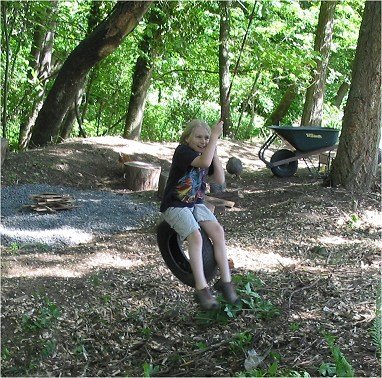
My hard-working husband took a break from hauling gravel and putting in garden beds to throw one of my old climbing ropes around this old tire that M. and a friend dragged out of the river last year. It took them about an hour to unstick it from the lovely muck it was embedded in, and figure out a way to carry it between the two of them (which involved using a long stick that they each carried an end of). They arrived back at our picnic spot covered in mucky goo, holding the tire between them on the stick like a muddy caricature of the hunters of yore, and insisting that we had to bring it home to use as a tire swing. Being as I am not as attached to the interior of my car as some might be, we found a way to wrap it in bags and newspaper and bring it along. It has sat in the garage ever since, my son resisting fiercely any attempt by my husband to recycle it, sure it would find it's place as our tire swing eventually. Now the day has come, the underbrush is sufficiently cleared out to have a good swinging spot, and you can see the happy expression on the tenacious tire hunter.
Tuesday, May 02, 2006
Chick Butts
How could I forget about the chick butts (and do you think I'll get lots of Google hits with a post title like that)? We just got our new baby chickens this weekend, and since we haven't had babies in a year, we had to go buy some starter feed, drag out the heat lamp, and of course I had to resume my role as the checker of the chick butts. Baby chicks are occasionally prone to a condition known as "pasting up" in professional poultry circles, which I won't go into great detail about except to note that I have to check and make sure they don't get chick poo on their back ends which can cause them no end of intestinal problems.
Of course, the chicks do not like this little exercise, and if last year is any indication the chicks will bond to everyone in the family but me. For months to come, even after they've outgrown the tendency to paste up, they will see me coming and take off: "Oh no! It's that crazy lady who wipes our butts!" Run!" This makes me the second least likely person to be able to catch a chicken if it accidentally gets somewhere it's not supposed to be. My daughter, who likes to pick up the chickens and carry them around singing to them, can catch any of them with ease. My son, who has a natural affinity for animals is pretty good at it too. My husband trying to catch a chicken is an act worthy of a vaudeville stage, however, and we have all gotten a few good belly laughs at his expense. Cheap entertainment here on the Blue Skies Farm, almost as good as a greased pig :) Now that I am the person who regularly takes out the kitchen scraps to the chickens, all I have to do is walk outside with a tupperware container in my hand and they will all follow me like the poultry pied piper. Apparently, the memories of the days when I was the tender of chicken butts has finally faded, as it hopefully will for today's chicks.
How could I forget about the chick butts (and do you think I'll get lots of Google hits with a post title like that)? We just got our new baby chickens this weekend,
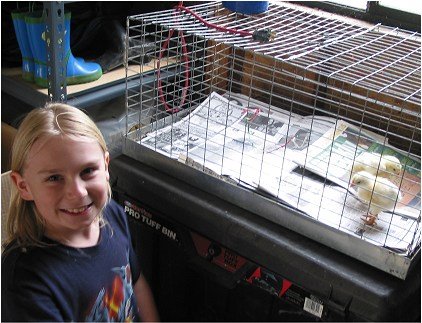 and since we haven't had babies in a year, we had to go buy some starter feed, drag out the heat lamp, and of course I had to resume my role as the checker of the chick butts. Baby chicks are occasionally prone to a condition known as "pasting up" in professional poultry circles, which I won't go into great detail about except to note that I have to check and make sure they don't get chick poo on their back ends which can cause them no end of intestinal problems.
 Of course, the chicks do not like this little exercise, and if last year is any indication the chicks will bond to everyone in the family but me. For months to come, even after they've outgrown the tendency to paste up, they will see me coming and take off: "Oh no! It's that crazy lady who wipes our butts!" Run!" This makes me the second least likely person to be able to catch a chicken if it accidentally gets somewhere it's not supposed to be. My daughter, who likes to pick up the chickens and carry them around singing to them, can catch any of them with ease.
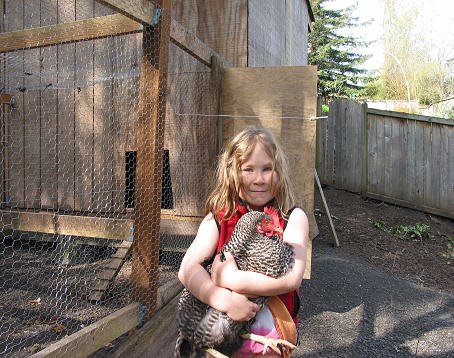 My son, who has a natural affinity for animals is pretty good at it too. My husband trying to catch a chicken is an act worthy of a vaudeville stage, however, and we have all gotten a few good belly laughs at his expense. Cheap entertainment here on the Blue Skies Farm, almost as good as a greased pig :) Now that I am the person who regularly takes out the kitchen scraps to the chickens, all I have to do is walk outside with a tupperware container in my hand and they will all follow me like the poultry pied piper. Apparently, the memories of the days when I was the tender of chicken butts has finally faded, as it hopefully will for today's chicks.
Subscribe to:
Posts (Atom)