Showing posts with label locavore. Show all posts

Tuesday, November 23, 2010

Getting Ready For the Dark Days Challenge

Yes, it's that time of year again. Over at the Urban Hennery, they are once again challenging us to think local, to source local, to eat local. It's the 4th Annual Dark Days Challenge and I'm planning to do it again. Yes, it's tough to find local foods in the dark of winter when the garden is buried under snow and the locally available vegetables consist of kale and, well, kale. I like kale, so that's not a problem, but there's only so much of it one can eat.


One thing I've found from participating in the challenge in the past is that when you forge new local connections for food sources, you tend to keep utilizing them in the months to come. Or you think out of the box and plan for ways to eat more locally in the winter. For instance, I cut the Zucchini That Ate New York into small cubes and put it into freezer bags in my chest freezer. I like to use zucchini with my eggs in the morning, so I can just take a handful out of the freezer and fry them up whenever I need them. That's a great easy way to add local vegetables during a season when I can no longer grow them.

My locavore omelette includes eggs from my chickens, local goat's milk, spinach and tomatoes from my garden, pork sausage from a local pig (in my freezer) and chantrelle mushrooms harvested locally. I'll be finding more ways to eat locally in the dark days to come!


Thursday, November 12, 2009

Nice Website for Local Foods and Prep


I was looking online for a recipe for fresh pumpkin pie (since all the Betty Crockerish cookbooks carry is recipes with canned pumpkin) and stumbled across this nifty little site: http://www.pickyourown.org/

From the website description:
This website provides local listings of pick your own (also called U-pick or PYO) farms in the United States, Canada, Britain, Australia, New Zealand, South Africa and other countries. There are crop calendars for each local area to tell you what is available to pick throughout the year, local weather forecasts and really easy illustrated directions to show you how to make jam, jelly, salsa, pickles, spaghetti sauce, applesauce, apple butter and 150 other recipes with step-by-step directions to can, freeze, dry or preserve the harvest.


So far, our family can vouch for their pumpkin pie recipe. This is a great time to get deals on pie pumpkins at local farms, with the Halloween rush over and the Thanksgiving rush not quite yet starting. I'm really enjoying the roasted pumpkin seeds too. There's nothing commercially available that even comes close to my home-roasted seeds, which is a bummer because they usually go fast around here!

Sunday, May 03, 2009

Swine Flu: As If We Needed One More Reason To Buy Local & Organic

As if there weren't enough reasons to buy local, humanely-raised, sustainably-farmed, locally-butchered organic meats, now there's the swine flu. Evolved from a strain that emerged in 1998 on factory farms in the U.S. and forged in the pathetic conditions of over-crowded, immune-stressed hogs shipped across the country from farm to slaughterhouse, we now have a highly-transmissable and dangerous flu jumping to humans.

For more reading on this subject, Wired Science has an article about the evolution of the latest swine flu from its 1998 origins, and the Humane Society's Factory Farming Campaign has more information as well.

What can we do to prevent future outbreaks? Either don't eat meat, or refuse to eat factory-farmed meat. Seek out local sources for meat, milk, and eggs. Look your food and food-producers in the eye and see the conditions in which they live. What's good for them is good for us. Remember that being green isn't just about saving the Earth, it's about saving us humans on it too.

Thursday, December 18, 2008

Dark Days "Special Eggs" and Pumpkin Pie


For this week, I fell back on an easy mostly locally-sourced favorite for our main dish. Our family calls it "special eggs", since that's what my son started calling it years ago when he was younger. I make eggs scrambled with milk, sun-dried tomato pesto, feta cheese, and chives. Each year I've been sourcing more and more of the ingredients. First the eggs, from our chickens starting 3 years ago. Then the goat milk, about a year after that, then the cheese, which I got at the Farmer's market last week, and the chives from our garden. Only the sun-dried tomato pesto is not local, but next year when we grow a bigger tomato crop, I plan on making that myself.


But the tour de force of this week's preparations was a homemade pumpkin pie. I've been skimming the cream off of our raw milk to save for making pie. I picked sugar pie pumpkins to grow in our garden this year so that the ones that didn't get turned into jack-o-lanters could be made into yummy pies. The kids helped pick them, then we roasted the halves, toasted the seeds for snacking, and mixed with eggs, cream, and spices for a pie that the kids pronounced "the best pumpkin pie we've ever had!"

My tip for pumpkin pies: if you have extra pie fillings, pour it into ramequins and bake for a crust-less pumpkin custard. Top with whipped cream or eat plain. Our entire family likes to eat this for breakfast!

Tuesday, December 09, 2008

Crying Over Spilt Milk

You know the old saying "don't cry over spilt milk"?? That one never made sense to me when I was a kid. I mean, you spill some milk, so what? You clean it up, you go to the store and get another gallon of milk. Big deal.

Now that we're getting our milk locally and only once a week, I would certainly cry if we spilled one of our precious half gallons. As it is, if we use some for one thing, we have to go a little short on something else. Of course, we've still got the option of going to the store and getting some cow's milk for Wayne and I to drink (only the kids are allergic and need the goat's milk), and luckily for us we can actually get local, organic cow's milk in glass bottles at our corner market. People who invented the saying about crying over spilled milk I'm sure didn't have that option. They had whatever came out of the cow, goat, or sheep that day, and that was it.

Now that it's winter and our hens aren't laying as much, eggs are another precious commodity. I dropped one a couple of nights ago coming back from the chicken coop and knew that meant one less egg for breakfast. It may seem archaic to live from hen or goat to mouth as it were, but I also think it brings with it a much greater appreciation of both your food and its source.

Mackenzie just read Old Yeller and its sequel Savage Sam. The picture of pioneer life it paints shows just how tenuous their hold on basic survival was. Their food for the winter depended on keeping the raccoons and skunks out of their corn patch and the wild animals away from their drying salted meat. Any excess milk had to be made into cheese or butter or it couldn't be kept.

I also just finished reading Life As We Knew It, which will really get you to thinking about all the conveniences of modern life, and how well you would cope if they all suddenly disappeared. Would you be making do, or crying over spilt milk? It's a reasonable read if you're interested in how the world might cope without its current transportation system (though that's not really the theme of the book or anything).

Wednesday, December 03, 2008

Local Meal, Dark Days Challenge


Since my computer crash, it's been hard for me to get time to post about our local eating, but we're still doing the Dark Days Challenge here. Our Thanksgiving wasn't a 90% local meal, but we did try to incorporate a lot of local foods into our Thanksgiving dinner. The best surprise from that was that when you use really great ripe, fresh local cranberries then cranberry sauce tastes AMAZING. It's nothing like that stuff you get in a can, or even the stuff I've made from scratch before. Luckily, Oregon is a major grower of cranberries, not too far from here on the coast. Unfortunately, our local supermarket (who used to be better about showcasing local growers) had bags of Ocean Spray cranberries from Vermont out on their Thanksgiving display! I had to ask where the local cranberries were, and I was so glad that I did. They were wonderful. We also had local greens and veggies, and I made a pumpkin pie from scratch with pumpkins from our garden, cream from our local raw goat's milk, and eggs from our own chickens. The kids proclaimed it the best pumpkin pie ever!

So on to our local meal for this week. I decided to make San Francisco Stew, a recipe from my grandma, it's like a savory chili with some bacon and brown sugar. We're quite lucky here as it's very easy to source a lot of local foods. Our small corner grocery that's a few blocks away sells local grass-pastured ground beef, so I picked up a pound of that. We buy a 1/3 of a pig each year and have it butchered, so that takes care of the bacon.

I was fortunate enough to get in on a bulk order of dried pinto beans a couple of months ago. They're local and transitional organic. Still, they have a fair bit of dirt and rocks included, so first Asa had fun sorting beans from rocks. Then we brought them to a boil and then let them soak overnight.


At our karate dojo, someone brought in a basket of onions and garlic from their garden for free, so those were chopped up and cooked up with the ground beef and bacon.
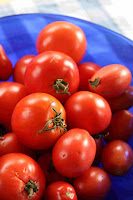
Last month, my mom told me that if I gathered in all of the green tomatoes from my garden and individually wrapped each one in newspaper and kept them cool, they'd ripen up on their own. So I unwrapped all of my tomatoes and lo and behold had some gorgeous red ones from my own garden. Those went into a pot to boil down into tomato sauce for the stew base.

To this I added the only non-local ingredients: salt, pepper, and some brown sugar (there aren't many local sugarcane sources in the Pacific Northwest! though I might experiment with substituting honey in the recipe in the future).

Along with the stew, we had peppers and purple carrots from our garden (the last of the peppers, but I still have a few more carrots left), and for dessert some yummy homemade applesauce from some windfall apples that my neighbor said I could glean from their trees.

With all of the various ingredients that we were able to grow, glean, trade, or buy locally, I'd say this meal was about 99% local, very cool! I love that this challenge really got me thinking about what I could use from around here.